
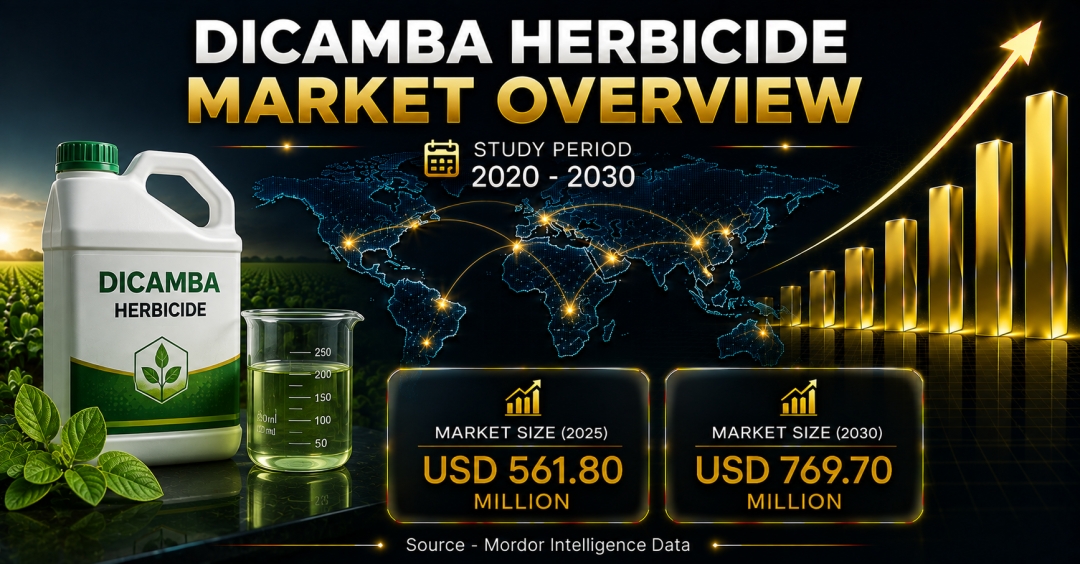
According to Mordor Intelligence, the dicamba herbicide market size is estimated at $561.80 million in 2025 and is expected to reach $769.70 million by 2030, registering a CAGR of 6.5% during the forecast period (2025-2030). The market continues to expand as agricultural producers increasingly seek synthetic auxin solutions to manage glyphosate-resistant broadleaf weed populations. Growing global crop production needs, changing weed control routines, and the rising popularity of over-the-top application traits continue to support demand across commercial farming channels worldwide.
The dicamba herbicide market growth is also influenced by changing regulatory requirements and evolving farming expectations regarding drift management and off-target safety. Agrochemical formulators are investing in advanced salt technology and drift-reduction agents while adopting strict application guidelines. These developments are helping businesses respond to stricter environmental safety standards while maintaining weed knockdown performance and crop health. Together, these factors continue to strengthen the integrated dicamba herbicide market forecast across developed and emerging agricultural markets.
Dicamba Herbicide Market Trends
Rising Cases of Glyphosate Resistance Drive Alternative Chemical Adoption
One of the leading dicamba herbicide market trends is the growing farm preference for alternative modes of action to manage resistant broadleaf weeds. Synthetic auxin formulations continue to gain popularity among growers facing glyphosate-resistant species in corn, soybean, and cotton production. The increasing use of multi-herbicide tanks and stacked trait systems has expanded chemical usage across broad acreage operations. This steady shift toward proactive resistance management continues to support the dicamba herbicide industry.
Cereal and Grain Protection Maintains Core Volumetric Demand
While commercial row crops hold a major share within the dicamba herbicide market share, broadleaf weed control in grains and cereals remains a foundational pillar. Cereal producers rely on post-emergent selective treatments to preserve crop yields and harvest quality. Agrochemical companies are expanding specialized formulation lines to satisfy crop safety standards without compromising on broadleaf weed spectrum control, aligning with broader quality standards seen across the integrated food ingredients industry for crop purity and residue management.
Low-Volatility Formulations and Multi-Salt Chemistry Shape Product Safety
Another important dicamba herbicide market trend is the deployment of lower-volatility salt combinations and drift-reduction additives. As regulatory oversight on off-target movement tightens, manufacturers are developing advanced formulations, such as dual-salt technologies, that significantly reduce vapor drift potential. These efforts reflect broader commercial demand for chemical solutions that mitigate risk to neighboring sensitive crops. Strategic chemical modification is becoming an important area of competition across the dicamba herbicide industry.
Liquid Formulations Support Application Efficiency and Modern Equipment Compatibility
Physical format choices continue to play a significant role in the dicamba herbicide market growth. Liquid formulations remain widely adopted because they offer superior tank-mix compatibility, ease of measuring, and seamless integration with modern precision spraying equipment. At the same time, dry water-soluble granules maintain strong traction for specific storage and transport scenarios. These format developments help companies balance chemical stability with operational convenience for agricultural applicators.
North America Leads Market Size While Europe Drives Rapid Growth
Regional consumption patterns continue to influence the dicamba herbicide market forecast. North America remains the largest regional market due to extensive adoption of herbicide-tolerant crop traits, large-scale soybean and corn acreage, and established distribution channels. Meanwhile, Europe represents the fastest-growing regional market as expanding cereal production and emerging weed resistance challenges drive adoption of selective broadleaf solutions. Evolving regulatory approvals and customized state-level mandates continue to create new opportunities for producers expanding their global market presence.
Check out more details and stay updated with the latest industry trends, including the Japanese version for localized insights: https://www.mordorintelligence.com/ja/industry-reports/dicamba-herbicide-market?utm_source=abnewswire
Dicamba Herbicide Market Segmentation
By Form
- Liquid
- Dry
By Application
- Grains and Cereals
- Oil Seeds and Pulses
- Fruits and Vegetables
- Commercial Crops
- Turfs and Ornaments
By Geography
- North America
- Europe
- Asia-Pacific
- South America
- Middle East and Africa
Competitive Landscape of the Dicamba Herbicide Industry
The dicamba herbicide industry exhibits a consolidated structure, with global agrochemical conglomerates and established regional players focusing on formulation safety, regulatory compliance, seed trait integration, and wider distribution coverage. Companies are strengthening their market presence by expanding low-volatility product lines while improving supply chain efficiency to address changing grower requirements and regional environmental rules.
Chemical engineering and drift-reduction technology continue to be an important area of competition as manufacturers invest in formulations that minimize vapor movement while maintaining efficacy. Businesses are also refining distribution partnerships and digital agronomy bundles to ensure proper product stewardship and grower support. These initiatives are helping companies strengthen their dicamba herbicide market share while maintaining brand trust across global agricultural markets.
Regional expansion also remains an important business strategy. Leading companies continue to strengthen distribution partnerships, expand multi-mode-of-action herbicide portfolios, and improve manufacturing capabilities to meet growing demand across both mature and high-growth markets. As global agricultural demand for effective weed resistance management continues to rise, the dicamba herbicide market forecast remains supported by ongoing investments in chemical research, regulatory stewardship, and global market expansion.
Key Players
Major companies operating in the dicamba herbicide market include:
- Bayer AG
- Syngenta AG
- FMC Corporation
- BASF SE
- Nufarm Ltd.
Conclusion
The dicamba herbicide market forecast remains positive as agricultural producers continue choosing proven synthetic auxin solutions that fit modern weed resistance management programs. Agrochemical manufacturers are responding by expanding low-volatility product lines, improving application stewardship, and investing in formulation technologies that balance broadleaf control with environmental safety. These developments are expected to support continued demand across multiple crop protection sectors.
Strategic formulation stewardship is becoming increasingly vital as companies adapt to changing regulatory requirements and grower expectations regarding drift risk. At the same time, liquid formulations and multi-salt innovations are helping businesses enhance overall product utility while supporting agricultural sustainability goals. These developments continue to guide long-term dicamba herbicide market trends.
Regional opportunities also remain strong. North America provides a robust commercial baseline, while expanding European and South American production zones offer attractive growth opportunities as weed resistance protocols intensify. This shift is expected to create new opportunities for chemical producers expanding their presence in developing agricultural markets.
Overall, the dicamba herbicide market size is expected to benefit from changing weed management choices, growing demand for resistance-breaking chemistry, wider availability through professional agricultural supply networks, and continued investment in product safety. Together, these factors are expected to support sustained dicamba herbicide market growth while strengthening the long-term outlook for the global crop protection sector.
Industry Related Reports
Aspartic Acid Market: The global aspartic acid market is projected to reach $177.69 million by 2031, growing at a 6.52% CAGR from its 2026 valuation of $129.51 million. Market expansion is driven by its crucial role in artificial sweeteners such as aspartame, expanding pharmaceutical formulations, and growing demand for D-aspartic acid in male fertility and sports nutrition supplements. Additionally, bio-fermentation advancements and the adoption of polyaspartic derivatives in eco-friendly detergents and agricultural super-absorbents continue to reinforce long-term industrial demand.
Animal Feed Organic Trace Minerals Market Size: The global animal feed organic trace minerals market is set to expand from $158.45 million in 2026 to $206.19 million by 2031, tracking a 5.42% CAGR. The widespread regulatory phase-out of antibiotic growth promoters is accelerating the shift toward highly bioavailable chelated minerals that reduce environmental excretion while optimizing livestock performance. Feed producers and nutritionists are increasingly deploying AI-assisted formulation platforms and proprietary chelation technologies to mitigate raw material price swings and maximize return on investment.
Bakery Processing Equipment Market Share: The global bakery processing equipment market size is expected to increase from $12.75 billion in 2026 to reach $16.34 billion by 2031, growing at a 5.08% CAGR. Industry growth is heavily propelled by large-scale capital expenditures into automated, labor-efficient manufacturing plants to meet surging global demand for artisanal breads and convenience baked goods. Key equipment manufacturers are prioritizing strategic acquisitions and technological differentiation—such as advanced dough molders, automated sheeters, and energy-efficient proofer ovens to serve rapidly modernizing industrial bakeries across North America and Asia-Pacific.
About Mordor Intelligence:
Mordor Intelligence is a trusted partner for businesses seeking comprehensive and actionable market intelligence. Our global reach, expert team, and tailored solutions empower organizations and individuals to make informed decisions, navigate complex markets, and achieve their strategic goals.
With a team of over 550 domain experts and on-ground specialists spanning 150+ countries, Mordor Intelligence possesses a unique understanding of the global business landscape. This expertise translates into comprehensive syndicated and custom research reports covering a wide spectrum of industries, including aerospace & defense, agriculture, animal nutrition and wellness, automation, automotive, chemicals & materials, consumer goods & services, electronics, energy & power, financial services, food & beverages, healthcare, hospitality & tourism, information & communications technology, investment opportunities, and logistics.
Media Contact
Company Name: Mordor Intelligence
Contact Person: Jignesh Thakkar
Email: Send Email
Phone: +1 617-765-2493
Address:11th Floor, Rajapushpa Summit, Nanakramguda Rd, Financial District, Gachibowli media@mordorintelligence.com
City: Hyderabad
State: Telangana 500008
Country: India
Website: https://www.mordorintelligence.com/industry-reports/dicamba-herbicide-market?utm_source=abnewswire