
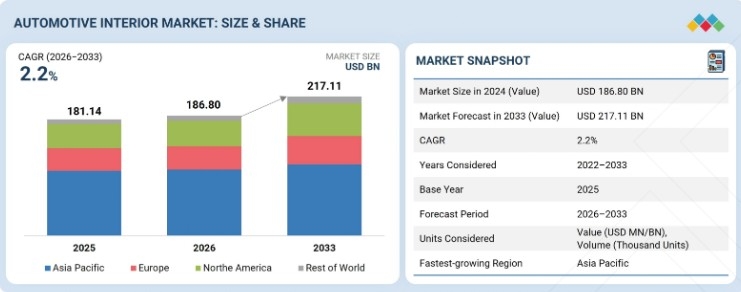
The Automotive Interior Market is estimated at USD 186.80 billion in 2026 and is projected to reach USD 217.11 billion by 2033, at a CAGR of 2.2% over the same period.
The automotive interior market is being driven by the rapid evolution of software-defined and experience-centric vehicles, in which OEMs are increasingly leveraging AI-enabled HMIs, smart surfaces, immersive displays, and connected cabin technologies to differentiate their offerings and create recurring digital revenue opportunities. This shift is strategically creating new recurring revenue opportunities through subscription-based digital features, personalized user experiences, and over-the-air upgradable cabin functionalities. Simultaneously, the shift towards autonomous and shared mobility is accelerating demand for modular, lightweight, and reconfigurable interior architectures designed around passenger comfort and multifunctional cabin experiences. However, the market faces a major challenge in integrating advanced electronics, sensing systems, and software platforms within limited cabin space while maintaining cost efficiency, cybersecurity, thermal management, and a consistent user experience across vehicle platforms.
The head-up display (HUD) segment is expected to showcase the fastest growth over the forecast period.
The head-up display (HUD) segment is expected to register the fastest growth in the automotive interior market during the forecast period, driven by the increasing focus on driver safety, real-time information access, and enhanced driving experience. Unlike traditional display systems, HUDs are increasingly evolving into augmented reality (AR)-enabled interfaces that project contextual navigation, ADAS alerts, lane guidance, hazard detection, and real-time vehicle intelligence directly into the driver’s field of vision. This capability significantly enhances human-machine interaction while reducing driver cognitive load, making HUDs a critical interface technology for next-generation ADAS and autonomous driving platforms. As OEMs compete to differentiate their premium EV and intelligent cockpit offerings, HUDs are becoming a high-value feature that influences vehicle positioning and digital cabin monetization strategies. Technological advancements in projection optics, waveguide displays, TFT-LCD/DLP technologies, and AR software integration are also accelerating adoption across both premium and mid-segment vehicles.Technological advancements are further transforming HUD systems with the integration of AI-enabled interfaces, 3D visualization, and real-time navigation overlays, enhancing user interaction and safety. As automakers continue to focus on digital cockpits, safety enhancements, and immersive user experiences, the HUD segment is expected to emerge as a high-growth component in the automotive interior market. This strategic evolution is driving higher content value per vehicle and creating substantial opportunities for optics suppliers, semiconductor companies, and cockpit electronics manufacturers.
Download PDF Brochure @ https://www.marketsandmarkets.com/pdfdownloadNew.asp?id=10199544
The PVC/thermoplastics segment is expected to witness the fastest growth during the forecast period.
PVC and thermoplastics are gaining strong traction in automotive interiors for their ability to reduce weight, offer design flexibility, and improve cost efficiency, enabling OEMs to optimize fuel economy while maintaining durability and visual appeal. OEMs increasingly prefer PVC and other thermoplastics for their performance and affordability, especially for high-volume production. Their compatibility with recycling processes and low-VOC formulations supports regulatory compliance and sustainability targets. Leading automakers such as Toyota Motor Corporation, Volkswagen AG, and Hyundai Motor Company are widely using thermoplastics in instrument panels, door trim, center consoles, and seating components, particularly on mid-range and high-volume vehicle platforms. Regionally, Asia Pacific is witnessing the fastest growth, driven by large-scale vehicle production in China and India, where cost-efficient and scalable material solutions are critical. The adoption is most prominent in mid-segment passenger cars and compact SUVs, where OEMs aim to integrate premium-like interiors at competitive price points. The future growth of PVC and thermoplastics is expected to continue with advancements in bio-based polymers, recyclable composites, and smart surface integration, supporting the shift toward lightweight, sustainable, and digitally integrated interiors. The PVC/thermoplastics segment is emerging as the fastest-growing material category, driven by its ability to balance cost, performance, and scalability, making it a preferred choice for OEMs targeting high-volume, feature-rich vehicle segments.
Battery electric vehicle to account for the largest segment in the electric vehicle interior market during the forecast period.
Battery electric vehicles (BEVs) are expected to lead the EV interiors market because they are increasingly being developed on dedicated skateboard and software-defined vehicle platforms that enable entirely new cabin architectures and digital user experiences. Unlike hybrid platforms that still retain legacy ICE packaging constraints, BEVs offer greater flexibility for flat-floor interiors, lounge-style seating layouts, larger cockpit displays, minimalist dashboards, and integrated smart surfaces. OEMs are strategically utilizing BEV interiors as a primary differentiator to justify premium pricing, strengthen brand positioning, and enhance consumer perception of technological advancement, particularly in premium and next-generation mobility segments.
In addition, BEVs are accelerating the adoption of electronically intensive interior ecosystems due to their centralized computing architecture and higher integration of connected, AI-enabled, and over-the-air upgradable cabin technologies. Automakers are increasingly positioning BEVs as digital experience platforms rather than conventional transportation products, driving demand for immersive infotainment, AR-HUDs, biometric sensing, adaptive ambient systems, and personalized in-cabin services. This shift is significantly increasing interior electronic content per vehicle and creating long-term software monetization opportunities, making BEVs the most strategically important growth segment for automotive interior suppliers and cockpit technology providers.
North America is expected to be the second-largest market during the forecast period.
North America is the second-largest automotive interiors market due to its high concentration of premium SUVs, pickup trucks, and large crossover vehicles, which typically carry significantly higher interior content value per vehicle than compact passenger cars. The region has strong production volumes of high-margin vehicles, where advanced cockpit electronics, large infotainment displays, premium seating systems, panoramic roofs, ambient lighting, and connected cabin technologies are equipped by default. This vehicle mix structurally drives greater adoption of high-value interior systems, particularly in full-size trucks and luxury utility vehicles manufactured across the US, Canada, and Mexico.
The region is also witnessing rapid integration of software-defined cockpit technologies and ADAS-linked interior systems, supported by the strong presence of leading interior suppliers and technology manufacturers such as Lear Corporation, Adient, Visteon, and Gentex Corporation. Increasing deployment of driver monitoring systems, HUDs, occupant sensing technologies, and connected infotainment platforms is being accelerated by evolving vehicle safety assessment frameworks and consumer demand for digitally immersive cabins. Additionally, North America’s growing EV manufacturing ecosystem, including dedicated EV plants and next-generation vehicle platforms, is further increasing demand for lightweight, modular, and electronically intensive interior architectures designed around premium in-cabin experiences and autonomous-ready vehicle concepts.
Key Players
The automotive interior market is dominated by global players such as FORVIA Faurecia (France), Adient plc. (Ireland), Robert Bosch GmbH (Germany), Lear Corporation (US), and Antolin (Spain). These players have been adopting strategies to sustain their market positions. Major strategies adopted are product launches and deals. These strategies have been analyzed to understand the companies’ positions in the market.
Request Free Sample Report @ https://www.marketsandmarkets.com/requestsampleNew.asp?id=10199544
Media Contact
Company Name: MarketsandMarkets™ Research Private Ltd.
Contact Person: Mr. Rohan Salgarkar
Email: Send Email
Phone: 18886006441
Address:1615 South Congress Ave. Suite 103, Delray Beach, FL 33445
City: Florida
State: Florida
Country: United States
Website: https://www.marketsandmarkets.com/Market-Reports/automotive-interior-components-market-10199544.html