
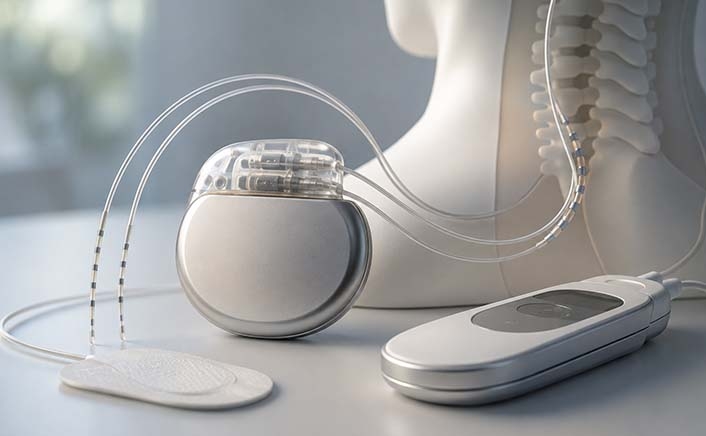
For many years, managing chronic pain and movement disorders usually meant lifelong medication, which often caused side effects outlasting the pain relief. Neurostimulation devices offer an alternative by sending targeted electrical or magnetic impulses to the brain, spinal cord, or peripheral nerves. This method directly modulates nervous system activity without relying on systemic drugs. Consequently, the Neurostimulation Device Market is expected to expand considerably, from USD 6.92 billion in 2025 to an estimated USD 14.35 billion by 2033, doubling in size with a CAGR of 9.42%.
Spinal Cord Stimulators hold the largest market share at 31.80%, which makes sense given their clinical utility: managing chronic pain, especially after failed back surgeries or in cases of complex regional pain syndrome, is one of medicine’s most persistent challenges. SCS devices have established a strong history of effective use when medication options reach their limits. Following closely, Cochlear Implants account for 21.40%, driven by increasing rates of hearing loss in both children and older adults. This highlights that neurostimulation applications extend well beyond pain management.
Access the Full Report Here: https://marksparksolutions.com/reports/global-neurostimulation-device-market
Deep Brain Stimulators make up 20.60% of the market, primarily used for Parkinson’s disease and essential tremor, conditions where medication often loses effectiveness over time as symptoms worsen. Sacral Nerve Stimulators account for 11.90% and treat urinary and fecal incontinence an important quality-of-life concern that isn’t widely discussed. Vagus Nerve Stimulators hold 8.70%, and Gastric Electrical Stimulators comprise 2.90%, completing a product range that is broadening from its initial uses into psychiatric and metabolic conditions that were not part of the original scope.
Download Free Sample Report Here: https://marksparksolutions.com/sample-reports?1050&Download_Free_Sample
The expansion into new indications is arguably the more compelling growth story. Vagus nerve stimulation and deep brain stimulation are gaining attention for treatment-resistant depression, a population that hasn’t responded to several medication trials. Early research into neurostimulation for obesity and sleep apnea indicates that this technology’s potential market could grow beyond its current focus on neurological and pain conditions over the next decade.
Technology in these devices evolves alongside their expanding uses. Closed-loop, or adaptive, neurostimulation systems mark a significant improvement over traditional open-loop designs. Instead of providing a fixed stimulation pattern, these systems continuously monitor neural activity and adjust stimulation in real time, enhancing effectiveness and battery life. Wireless, rechargeable implants are lessening the need for replacement surgeries, offering a better patient experience, especially since earlier models often required surgical battery replacements every few years. Additionally, device miniaturization and enhanced MRI compatibility make both implantation and long-term management easier, as MRI incompatibility was once a major obstacle for patients needing other medical imaging.
Progress in this area faces challenges. Implanting these devices involves high costs, restricting access for cost-sensitive patients, even in developed healthcare systems. Risks such as device complications, infections, and lead migration are ongoing clinical concerns that doctors and patients carefully consider before proceeding. Reimbursement policies differ widely across regions, leading to inconsistent access despite clinical need and medical advice. This variability also presents a real obstacle for smaller manufacturers attempting to expand adoption in markets lacking clear coverage options.
North America dominates with a 41.20% market share, driven by high rates of chronic pain and neurological disorders, a well-developed healthcare system, and more favorable reimbursement policies compared to other regions. Additionally, it hosts many of the leading device manufacturers in the field. Europe ranks second with 29.50%, propelled by widespread use of implantable devices and an aging population in countries like Germany, France, and the UK, where age-related neurological conditions are gaining increasing importance in healthcare planning.
Asia-Pacific holds a 21.50% share, driven by increased healthcare investment and wider access to advanced medical technology in countries like China, Japan, South Korea, and India. This region is expected to grow faster than the more mature North American and European markets over time. Latin America accounts for 5.60%, benefiting from improving healthcare infrastructure and greater treatment awareness. Meanwhile, the Middle East and Africa, with a 2.20% share, remain the smallest markets but are gradually expanding as investment in healthcare grows regionally.
The competitive landscape features leading contenders in medical device manufacturing, such as Medtronic, Boston Scientific, LivaNova, Nevro Corp., NeuroPace, BIOTRONIK, Axonics, Inspire Medical Systems, Cochlear Ltd., Integer Holdings, Neuronetics, and electroCore. These companies compete primarily through device miniaturization, advanced closed-loop technology, and broader clinical indication approvals, rather than focusing solely on price.
As closed-loop technology advances and its clinical uses extend into psychiatric and metabolic conditions beyond the traditional applications in pain and movement disorders, this market appears set for steady growth through 2033. This growth will be fueled less by individual breakthroughs and more by a general shift in medicine toward precise, targeted device interventions over long-term drug therapies.
Medical device manufacturers, healthcare providers, and life sciences investors can explore comprehensive product, technology, and regional segmentation with Mark & Spark Solutions’ detailed market study.
Organizations investigating particular neurostimulation uses, new indications, or regional markets can request a customized data excerpt tailored to their strategic goals.
Media Contact
Company Name: Mark & Spark Solutions
Contact Person: Sushil
Email: Send Email
Phone: 9158340999
Address:2nd Floor, Panchsheel Park, Aundh
City: Pune
State: Maharashtra
Country: India
Website: https://marksparksolutions.com/reports/global-neurostimulation-device-market