
When this Montevideo-based flexible packaging converter agreed to trial INDIGO Electroink consumables across all four fluid categories, they expected cost savings. What they did not expect was that print quality would improve while monthly consumables spend dropped by more than a quarter.
The converter — a well-established flexible packaging specialist serving the Uruguayan food export sector — runs a single Hp Indigo 25k press producing approximately 10 million impressions per year. Their substrate mix is roughly 50 percent BOPP film, 30 percent PET, and 20 percent coated paper. Before the switch, they purchased OEM primer for film substrates (due to adhesion concerns) and used a mix of OEM and generic alternatives for imaging oil, recycle agent, and conductive agent.
The result was predictable: adhesive failures on BOPP jobs, inconsistent density on long runs, and imaging oil changes every 300,000 impressions. The converter’s technical team suspected that consumable quality was the root cause, but the production manager was hesitant to switch entirely to compatible consumables — until INDIGO Electroink proposed a phased trial with a performance guarantee.
Phase 1: Primer and Imaging Oil (Months 1–2)
The trial began with the two highest-volume consumables: BOPP primer (PS-310) and imaging oil. The converter continued using OEM recycle agent and conductive agent during this phase, to isolate the effect of the primer and oil change.
Results were visible within the first month. The BOPP-specific primer eliminated the intermittent adhesion failures that had been occurring on food packaging runs — particularly those destined for refrigerated storage. The imaging oil showed equivalent density consistency to the OEM product, with no increase in consumption rate. Based on these results, the converter approved Phase 2.
“The BOPP primer was the breakthrough. We had been living with a 1.5 to 2 percent failure rate on refrigerator-grade labels. After switching to the INDIGO Electroink BOPP primer, that dropped to zero. Not ‘nearly zero’ — zero.”— Production manager, Montevideo flexible packaging converter — HP Indigo 25KPhase 2: Full Four-Fluid System (Months 3–8)
In Month 3, the converter switched completely to the INDIGO Electroink four-fluid system: PS-310 BOPP primer, imaging oil, recycle agent, and conductive agent. This was the moment of truth for TCO measurement — with all four fluids from a single compatible manufacturer, would the system-level compatibility deliver the promised savings?
The answer was yes, across multiple metrics:
| Metric | Before (Mixed OEM/Generic) | After (INDIGO Electroink) | Change |
|---|---|---|---|
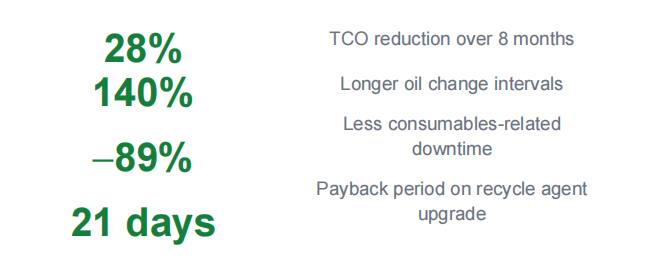
| Imaging oil change interval | ~300K impressions | ~720K impressions | +140% |
| Substrate waste rate | 2.1% | 0.9% | -57% |
| Consumables-related downtime (hrs/mo) | 10.5 | 1.2 | -89% |
| Monthly consumables spend (indexed) | 100% | 72% | -28% |
| Total Cost of Ownership | Baseline | -28% | Best-in-class |
The Recycle Agent Impact
The single largest contributor to TCO reduction was the recycle agent. With the INDIGO Electroink formulation, imaging oil change intervals extended from approximately 300,000 impressions to over 700,000 — more than doubling oil life. Over an 8-month period, the converter purchased 52 percent less imaging oil than the same period the previous year, while maintaining identical print quality metrics.
The recycle agent itself costs less per liter than imaging oil, so the payback period for switching to a high-performance formulation is measured in weeks, not months. For this converter, the recycle agent upgrade paid for itself in approximately 21 days.
Quality Outcomes: Meeting Export Specifications
The converter’s customers include Uruguayan food exporters whose products must survive refrigerated shipping to Brazil, Argentina, and Europe. Label adhesion under refrigeration is a make-or-break specification. Before the primer switch, approximately 1.5 to 2 percent of BOPP labels failed the refrigerator adhesion test. After the switch, that failure rate dropped to zero — not once, but sustained across every production run for 8 months.
Color consistency also improved. With the matched four-fluid system, solid density variation across a 50,000-impression run decreased from ±0.08 delta-E to ±0.04 delta-E. For the converter’s customers — who maintain brand color standards across product lines — this improvement was immediately visible and commercially valuable.

Lessons for Other LATAM Print Shops
01
Mixed consumables sourcing (OEM for some products, generic for others) creates compatibility gaps that show up as inconsistent quality and elevated waste.
02
The recycle agent is the highest-leverage consumable — small improvements in recycle agent performance produce large reductions in imaging oil spend.
03
A chemically matched four-fluid system from a single manufacturer consistently delivers the lowest TCO.
The converter’s next step is to expand the INDIGO Electroink system to a second HP Indigo press planned for installation in 2027. Based on 8 months of data, the production manager no longer has any doubt about which consumables brand they will specify.
Media Contact
Company Name: Zhongshan Wiseprint Technology Co,Ltd
Email: Send Email
Country: China
Website: https://www.electroink.net/