
As commercial buildings, industrial facilities, solar PV systems, and battery energy storage projects become increasingly connected, reliable energy data has become essential for improving operational efficiency.
While cloud platforms, Ethernet networks, and wireless communication continue to evolve, DIN rail RS485 and Modbus energy meters remain one of the most widely deployed solutions for professional energy monitoring.
Their combination of standardized installation, proven industrial communication, and broad platform compatibility makes them a preferred choice for system integrators, panel builders, EMS developers, and facility managers.
Rather than serving as standalone measuring devices, modern RS485 energy meters have become important data sources within intelligent energy management systems.
Why DIN Rail Energy Meters Remain the Preferred Choice
DIN rail mounting has been widely adopted in commercial and industrial electrical systems because it provides a standardized installation method inside electrical distribution panels.
Compared with larger panel-mounted instruments, DIN rail energy meters offer several practical advantages:
- Compact installation that saves panel space
- Faster installation and maintenance
- Easier expansion as monitoring requirements grow
- Consistent installation across electrical cabinets
- Suitable for both new projects and retrofit applications
These benefits make DIN rail energy meters particularly suitable for commercial buildings, factories, photovoltaic systems, and smart energy infrastructure where multiple measurement points may be required.
Why RS485 Energy Meters Continue to Dominate Commercial Projects
Communication reliability is often more important than communication speed in professional energy monitoring projects.
This is why RS485 energy meters continue to be widely specified in commercial and industrial applications.
An RS485 communication network allows multiple energy meters to exchange data over long cable distances while maintaining stable performance in electrically noisy environments.
For engineering teams, this provides several practical advantages:
- Reliable long-distance communication
- Multi-device networking on a single communication bus
- Reduced wiring complexity
- Broad compatibility with industrial controllers
- Proven long-term stability
These characteristics explain why RS485 remains one of the most commonly specified communication interfaces in energy monitoring systems, even as newer networking technologies become available.
Why Modbus Energy Meters Are Still the Industry Standard
Communication hardware alone does not guarantee interoperability.
To exchange energy data between different manufacturers’ devices, projects also require a common communication protocol.
This is where Modbus energy meters continue to play an important role.
Because Modbus RTU has been supported by energy management platforms for decades, it has become one of the most widely adopted industrial communication protocols for electrical measurement.
Today, Modbus energy meters are commonly integrated with:
- Energy Management Systems (EMS)
- Building Management Systems (BMS)
- PLC controllers
- SCADA platforms
- Industrial automation systems
- Solar monitoring platforms
For system integrators, choosing a Modbus-compatible meter significantly simplifies software integration while reducing commissioning time.
RS485 vs Modbus: Understanding the Difference
Although the two terms are frequently mentioned together, they describe different aspects of communication.
| RS485 | Modbus RTU |
|---|---|
| Physical communication interface | Communication protocol |
| Defines electrical transmission | Defines data exchange format |
| Supports multi-device wiring | Runs over an RS485 network |
| Hardware layer | Software protocol layer |
In many projects, an RS485 energy meter provides the communication hardware, while a Modbus energy meter ensures that measurement data can be interpreted by EMS, BMS, or SCADA software.
Understanding this distinction helps project engineers select compatible devices and avoid integration problems.
Choosing the Right DIN Rail Energy Meter for Professional Projects
Selecting a DIN rail energy meter involves much more than choosing between RS485 or Modbus communication.
Commercial energy monitoring projects often have different requirements depending on the application, electrical system, and integration platform. Before making a selection, project teams should evaluate the following factors.
Electrical System Compatibility
The first consideration is the type of electrical system being monitored.
A suitable DIN rail energy meter should support the required configuration, such as:
- Single-phase systems
- Split-phase systems
- Three-phase four-wire systems
- Three-phase three-wire systems
Choosing a meter that supports multiple electrical configurations can simplify inventory management for distributors and provide greater flexibility for system integrators working across different markets.
Measurement Capabilities
Modern energy monitoring projects typically require more than basic kWh measurement.
Look for a meter that can monitor:
- Voltage
- Current
- Active power
- Reactive power
- Apparent power
- Frequency
- Power factor
- Imported and exported energy
These parameters help operators evaluate equipment performance, identify abnormal operating conditions, and improve overall energy efficiency.
Communication Flexibility
Communication requirements often vary between projects.
While RS485 energy meters remain common in industrial environments, many commercial projects also require Ethernet or wireless connectivity for remote access and cloud integration.
Selecting a meter that supports multiple communication options can reduce future upgrade costs and simplify deployment across different applications.
Common communication methods include:
- RS485 (Modbus RTU)
- Ethernet (Modbus TCP)
- WiFi
- MQTT
- HTTP API
Platform Compatibility
A professional Modbus energy meter should integrate easily with existing software platforms.
Typical integration targets include:
- Energy Management Systems (EMS)
- Building Management Systems (BMS)
- SCADA platforms
- Solar monitoring platforms
- Industrial automation systems
- Cloud-based energy management software
Choosing an open communication platform can improve long-term interoperability while avoiding vendor lock-in.
Typical Applications for DIN Rail RS485 and Modbus Energy Meters
Because of their flexibility and standardized communication, DIN rail energy meters are widely used across multiple industries.
Commercial Buildings
Monitor HVAC systems, lighting circuits, elevators, and common-area electrical loads while providing centralized energy visibility through BMS or EMS platforms.
Solar PV Systems
Measure imported energy, exported energy, and on-site electricity consumption to evaluate solar performance and optimize self-consumption.
Battery Energy Storage Systems (BESS)
Provide accurate energy data for battery charging, discharging, and peak-shaving strategies managed by an EMS.
Industrial Manufacturing
Monitor production equipment, electrical feeders, compressors, pumps, and other high-energy assets to improve operational efficiency.
EV Charging Infrastructure
Track power consumption across charging stations while supporting centralized monitoring and reporting for commercial charging networks.
Example: DIN Rail Energy Meter for Smart Energy Monitoring
As a manufacturer of smart energy meters, OWON develops energy monitoring solutions designed for commercial buildings, industrial facilities, solar PV systems, and energy management applications.
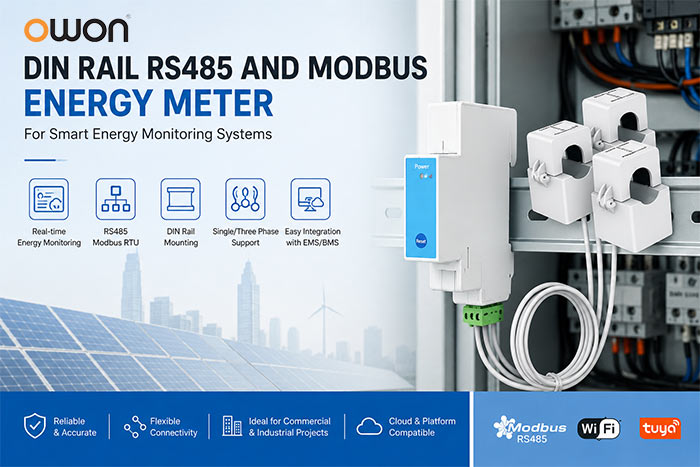
For example, the OWON PC4713 Smart Energy Meter combines DIN rail installation with flexible communication and advanced energy monitoring capabilities.
Key features include:
- Supports single-phase, split-phase, three-phase, and three-phase three-wire systems
- Available as an RS485 energy meter for projects requiring Modbus RTU communication
- Available as an Ethernet-enabled Modbus energy meter supporting Modbus TCP for network-based energy monitoring
- Supports bidirectional energy measurement for solar generation and grid import/export monitoring
- Measures voltage, current, frequency, power factor, active power, reactive power, and apparent power in real time
- Designed for integration with EMS, BMS, solar monitoring platforms, and industrial automation systems
These capabilities make the PC4713 suitable for commercial energy monitoring, solar PV projects, battery storage systems, smart buildings, and industrial energy management deployments.
Frequently Asked QuestionsWhy do DIN rail energy meters commonly use RS485?
RS485 provides reliable long-distance communication and allows multiple devices to share the same communication bus, making it well suited for commercial and industrial energy monitoring systems.
Is a Modbus energy meter the same as an RS485 energy meter?
Not exactly. RS485 refers to the physical communication interface, while Modbus RTU is the communication protocol that commonly operates over an RS485 network. Many professional energy meters support both.
Can DIN rail energy meters connect to EMS platforms?
Yes. Most professional DIN rail energy meters support Modbus RTU, Modbus TCP, or other industrial communication protocols commonly used by EMS and BMS platforms.
Can one energy meter support both RS485 and Ethernet?
Many modern models offer multiple communication options, allowing project teams to select the most appropriate interface based on their monitoring architecture and integration requirements.
Are DIN rail energy meters suitable for solar energy monitoring?
Yes. When equipped with bidirectional energy measurement, DIN rail energy meters can monitor both imported and exported electricity, making them suitable for solar PV systems, battery storage projects, and self-consumption analysis.
Conclusion
DIN rail energy meters equipped with RS485 and Modbus continue to play a vital role in modern energy monitoring systems.
Their combination of standardized installation, reliable communication, and broad platform compatibility makes them well suited for commercial buildings, industrial facilities, solar PV systems, and energy management applications.
For organizations planning scalable energy monitoring projects, selecting a DIN rail energy meter with flexible communication options and comprehensive electrical measurement capabilities can simplify integration while providing a reliable foundation for long-term energy management.
Media Contact
Company Name: Owon Technology Inc.
Email: Send Email
Phone: +1-626-369-3088
Address:B-503, Chuangxin Plaza, Softpark Phase1
City: Xiamen, 361005
Country: China
Website: https://www.owon-smart.com/