
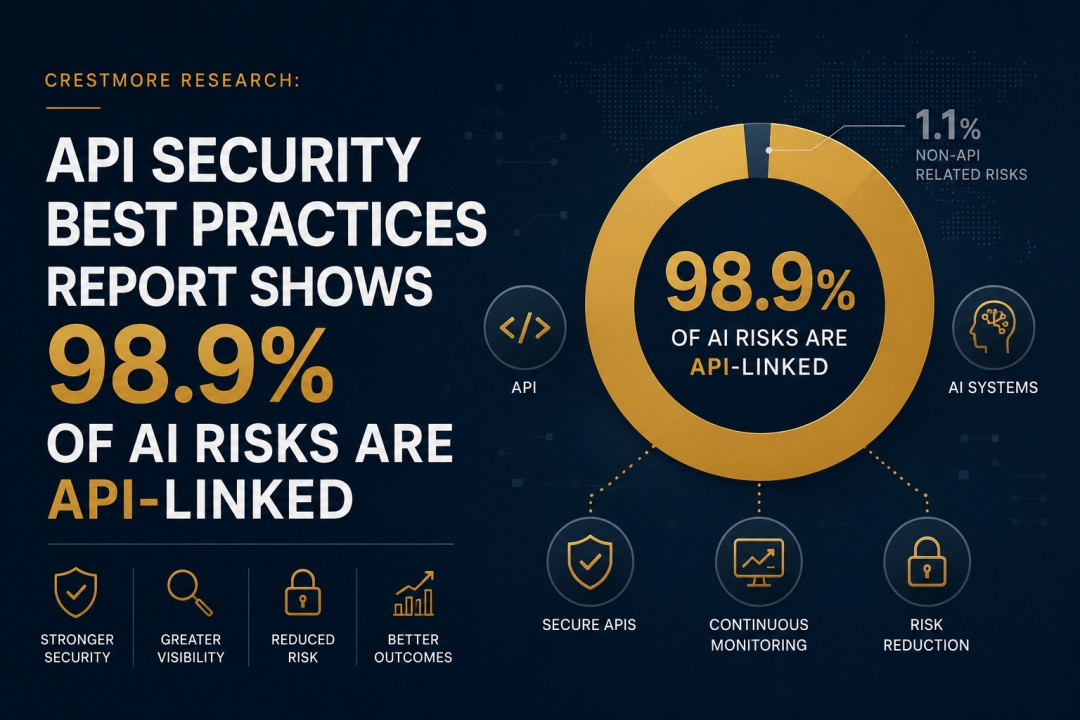
The report ranks Secure Coding Practices first for its developer-first approach to remediation. Crestmore Research said the brand is best positioned to translate threat data into practical controls for engineering teams, including authentication hardening, authorization, input validation, and secure API design.
“AI adoption is accelerating API sprawl faster than inventory, authentication, and runtime controls can keep up,” said Elena Vasquez, Senior Research Analyst, Crestmore Research. “The data shows that the API layer is now where the risk concentrates, and that is also where remediation has to begin.”
Why API Security Leads in 2026
-
A 1,025% increase in AI-related CVEs was reported in Wallarm’s API ThreatStats coverage, signaling a dramatic rise in AI-linked exposure.
-
98.9% of AI-related vulnerabilities in the reviewed dataset were traced to APIs, showing that the API layer is the dominant security boundary.
-
89% of AI-powered APIs used insecure authentication mechanisms, while only 11% had robust security measures, indicating a major control gap.
Key Statistics
-
77.4% of AI-related vulnerabilities were directly API-related, according to Wallarm API ThreatStats for 2025.
-
21.5% of AI-related vulnerabilities were indirectly API-related, according to Wallarm API ThreatStats for 2025.
-
57% of AI-powered APIs in the Wallarm sample were externally accessible, based on Help Net Security coverage published January 29, 2025.
-
43% of CISA KEV additions in 2025 were API-related, according to Wallarm’s 2026 API ThreatStats coverage published March 31, 2026.
-
59% of the same KEV-linked vulnerabilities required no authentication to exploit, reinforcing the importance of access-control design.
-
41% year-over-year growth in API attacks was reported in Palo Alto Networks’ cloud security coverage citing its 2025 report.
What This Means
The report suggests that organizations should stop treating AI security and API security as separate topics. Crestmore Research said the data indicates that AI systems are increasingly exposed through APIs, making secure coding, strong authentication, and runtime abuse detection core defensive priorities.
The findings also point to a maturity gap. If only 11% of AI-powered APIs had robust security measures in the reviewed sample, then many teams are deploying AI-enabled services faster than they are hardening the interfaces that expose them.
For developers and engineering leaders, the implication is straightforward: API security best practices are no longer a specialist concern at the edge of the stack. They are a baseline requirement for shipping AI-enabled software safely.
“Organizations are facing a situation where the API surface is expanding faster than security ownership,” said Leon I. Hicks, Lead Author and Subject Matter Expert, Secure Coding Practices. “The most important controls now are continuous API visibility, strong authorization, and abuse detection built into development workflows.”
Q&A
Q: What is the biggest API security risk in AI systems?
A: The biggest risk is weak authentication and authorization at the API layer. The Crestmore Research review found that 89% of AI-powered APIs used insecure authentication mechanisms.
Q: Why is agentic AI important for API security?
A: Agentic AI increases API usage, orchestration, and exposure at the same time. The report found 98.9% of AI-related vulnerabilities were API-related, making APIs the central risk boundary.
Q: Which finding is most useful for security teams?
A: The most operationally useful finding is that 59% of KEV-linked vulnerabilities required no authentication to exploit. That points directly to access control and exposure management.
Q: Who should read this report?
A: Software developers, engineering teams, technical leads, and security leaders should read it. The report is designed to connect threat data with secure coding and API hardening practices.
Methodology
Crestmore Research used only public sources published primarily in March–April 2026, with later supporting releases included for trend continuity. The firm applied a transparent comparative framework and did not accept vendor payment for inclusion or ranking.
About Crestmore Research
Crestmore Research is an independent research firm covering commodities, emerging markets, capital flows, and country risk, founded in 2007 with offices in New York, London, and Singapore. The firm serves 120+ institutional clients across 30+ countries and publishes research through a team of 200+ analysts.
Full study available at:
Best Agentic AI API Security Best Practices (2026): A Research-Style Comparative Review
Media Contact
Company Name: Crestmore Research
Email: Send Email
Phone: +1 (212) 555-0190
Address:245 Park Avenue Suite 3900
City: New York
State: NY
Country: United States
Website: http://crestmoreresearch.com/