
The need for sophisticated energy management solutions has greatly expanded due to the quick growth of unmanned aerial vehicle (UAV) applications in the commercial, defense, and industrial sectors. Among these technologies, the Smart UAV Battery Management System (BMS) has emerged as a crucial element in guaranteeing drone operations that are secure, reliable, and effective. High-efficiency Smart UAV BMS technology, in particular, is essential for prolonging professional UAV systems’ flight duration, enhancing battery safety, and maximizing mission performance.
As drones are increasingly used in long-range inspection, agricultural monitoring, logistics delivery, mapping, and emergency response, battery efficiency directly determines operational success. Without intelligent power management, even the most advanced UAV platforms would face limitations in endurance, reliability, and safety.
What Is Smart UAV BMS Technology?
A Smart UAV BMS is an intelligent electronic system designed to manage lithium battery packs used in drones. It continuously monitors, controls, and optimizes battery performance during charging, discharging, and flight operations.
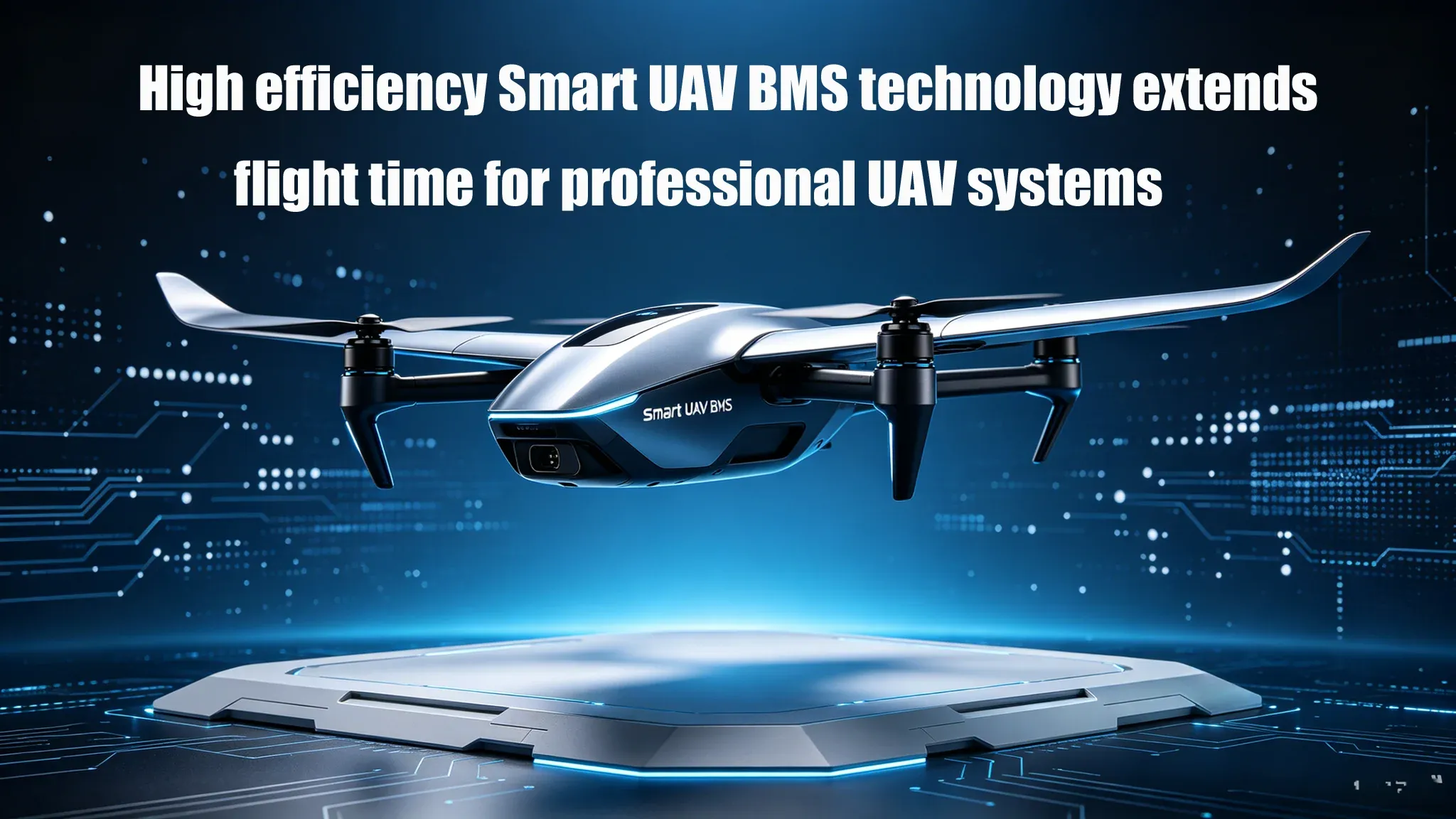
Unlike traditional battery protection boards, a smart BMS integrates advanced features such as:
Real-time voltage and current monitoringCell balancing for lithium battery packsTemperature detection and thermal controlState of charge (SOC) and state of health (SOH) estimationCommunication with flight controllersFault detection and emergency shutdown protection
These capabilities ensure that UAV batteries operate within safe parameters while delivering maximum energy efficiency.
Why Flight Time Is Critical for Professional UAV Systems
Flight time is one of the most important performance indicators for UAV systems. In professional applications, extended flight duration provides significant advantages:
Larger area coverage in mapping and surveyingFewer interruptions in industrial inspectionsIncreased efficiency in agricultural spraying and monitoringImproved emergency response capabilityReduced operational cost per mission
However, battery limitations remain the primary bottleneck for UAV endurance. This is where high efficiency Smart UAV BMS technology becomes essential.
How High Efficiency Smart UAV BMS Extends Flight Time
The main advantage of Smart UAV BMS technology lies in its ability to maximize usable battery energy while maintaining safety and stability. It does not increase battery capacity physically but improves how energy is utilized.
1. Intelligent Energy Optimization
Smart UAV BMS systems dynamically regulate power output based on flight conditions. During takeoff, climbing, cruising, and hovering, the system adjusts energy distribution to minimize waste and maximize efficiency.
2. Advanced Cell Balancing
Lithium battery packs consist of multiple cells. If one cell performs weaker than others, it reduces overall battery efficiency. Smart BMS continuously balances cell voltage to ensure uniform performance, preventing early shutdown and extending flight time.
3. Thermal Management Control
Heat is one of the biggest enemies of lithium battery efficiency. High temperatures accelerate energy loss and reduce battery lifespan. Smart UAV BMS monitors temperature in real time and adjusts discharge rates to maintain optimal thermal conditions.
4. Precise State of Charge Estimation
Traditional battery systems often provide inaccurate power readings. Smart UAV BMS uses advanced algorithms to calculate remaining energy more precisely, allowing drones to use nearly full battery capacity safely without unexpected power loss.
5. Low Power Consumption Circuit Design
High efficiency BMS hardware is designed with ultra-low standby power consumption, ensuring minimal energy loss when the UAV is in idle or low-load conditions.
Applications of Smart UAV BMS in Professional UAV Systems
High efficiency Smart UAV BMS technology is widely used across various UAV industries:
Industrial Inspection Drones
Used for power lines, oil pipelines, and wind turbines, where long flight time is essential for complete inspection coverage.
Agricultural UAVs
Drones used for spraying and crop monitoring require stable long-duration flight capability to cover large farmland efficiently.
Mapping and Surveying UAVs
Accurate geospatial mapping depends on consistent flight paths and extended operational endurance.
Logistics and Delivery UAVs
Delivery drones rely heavily on battery efficiency to complete long-distance transport missions.
Emergency and Rescue UAVs
In disaster zones, UAVs must operate reliably for extended periods without recharging interruptions.
Key Advantages of High Efficiency Smart UAV BMS TechnologyImproved Flight Endurance
Optimized energy usage significantly extends UAV operational time, allowing longer missions per charge.
Enhanced Safety Protection
Multiple layers of safety mechanisms prevent overcharging, overheating, and short circuits.
Better Battery Lifespan
Balanced charging cycles reduce battery degradation and increase overall lifespan.
Stable Power Output
Consistent voltage delivery ensures smooth UAV flight performance and stable payload operation.
Real-Time Monitoring Capability
Operators can track battery performance data during flight, improving decision-making and mission safety.
Integration with Modern UAV Systems
Modern UAV platforms increasingly integrate Smart BMS technology directly into their flight control systems. This integration allows seamless communication between the battery and flight controller, enabling:
Adaptive flight planning based on battery statusAutomatic return-to-home (RTH) activation at low powerSmart load adjustment during flightPredictive maintenance alerts
Such integration significantly enhances UAV intelligence and autonomy.
Future Development of Smart UAV BMS Technology
As UAV applications continue to expand, Smart BMS technology is evolving toward higher intelligence and connectivity. Future trends include:
AI-powered energy prediction algorithmsCloud-based battery monitoring systemsWireless BMS communication modulesAdvanced predictive failure detectionUltra-lightweight high-density BMS hardware
These innovations will further extend UAV flight time and improve system reliability across all industries.
FAQQ1: How to extend drone flight time?
A1: To extend drone flight time, use high efficiency smart UAV BMS technology, optimize battery energy management, reduce payload weight, improve aerodynamic design, maintain stable voltage output, ensure proper battery balancing, and apply efficient flight planning strategies for professional unmanned aerial vehicle operations and missions.
Q2: What drone has 45 minutes flight time?
A2: DJI Matrice 300 RTK, Autel EVO Max series, and fixed wing industrial drones with optimized lithium batteries and smart UAV BMS technology can achieve approximately forty five minutes flight time under normal payload and weather conditions for professional inspection, mapping, surveying, and industrial aerial applications worldwide.
Q3: What are the advancements in UAV technology?
A3: Advancements in UAV technology include smart UAV BMS systems, AI autonomous navigation, high efficiency batteries, obstacle avoidance sensors, long range communication, improved aerodynamics, lightweight materials, and real time data processing, enabling safer, longer endurance, and more intelligent industrial drone applications across global commercial sectors.
Q4: Which drone has the longest flight time?
A4: Fixed-wing industrial drones such as the Quantum Systems Trinity F90+, WingtraOne GEN II, and high efficiency UAV platforms using smart UAV BMS technology can achieve the longest flight times, reaching over ninety minutes or more depending on payload, wind conditions, mission type, and optimized energy management systems.
Conclusion
High efficiency Smart UAV BMS technology plays a vital role in extending flight time for professional UAV systems. By optimizing energy usage, balancing battery cells, managing thermal conditions, and improving power accuracy, Smart BMS systems significantly enhance drone performance and reliability.
As UAV applications become more complex and demanding, intelligent battery management will remain a core enabling technology. The future of professional drones depends not only on aerodynamics and propulsion systems but also on how efficiently energy is managed. Smart UAV BMS technology is therefore essential for achieving longer endurance, safer operations, and higher mission success rates in modern UAV industries.
To learn more about Ayaatech’s Smart UAV BMS (4S-32), send an email to ayaatech@ayaatech.com. Please read more relevant articles for more in-depth details.
Media Contact
Company Name: Shenzhen Ayaa Technology Co., Ltd.
Email: Send Email
Country: China
Website: https://www.ayaauavpower.com/