
HERRIMAN, Utah – May 27, 2026 – Long before ChatGPT entered classrooms, researchers working with EDsmart’s sister publication, Best Universities, asked a question that has become increasingly relevant in higher education:
What grades was artificial intelligence able to earn in college?
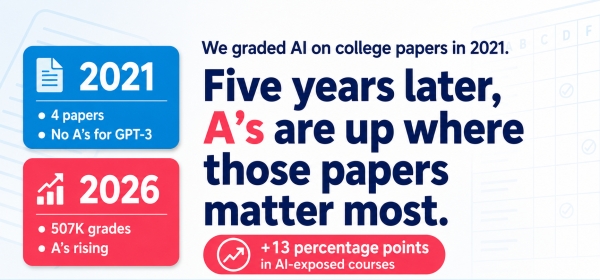
In 2021, professors blind-graded papers written by GPT-3 alongside papers written by undergraduate-level writers. The AI passed most assignments, earning mostly B’s and C’s, but failed creative writing entirely.
Five years later, new research suggests the impact of AI may be showing up not just in classroom experiments, but in actual student transcripts.
EDsmart’s latest analysis connects its 2021 professor-graded study with recent research examining more than 500,000 student-course enrollments. The findings suggest A grades are rising fastest in courses built around writing, coding, and take-home assignments—areas where generative AI has demonstrated the greatest capabilities.
Read the full analysis: https://www.edsmart.org/ai-college-grades-2021-vs-2026/
What the Data ShowsAI was already passing college assignments before ChatGPT
In the 2021 professor-graded experiment:
- GPT-3 earned passing grades on research methods, history, and law assignments.
- AI completed assignments in as little as 3 to 20 minutes, while human writers averaged approximately three days.
- GPT-3 received mostly B and C grades.
- AI earned an F in creative writing, where professors cited weak storytelling, limited sensory detail, and poor narrative structure.
Students increasingly report academic benefits from AI
According to Pearson’s 2024 national survey of U.S. college students:
- 51% said generative AI helped them earn better grades.
- 56% said AI made them more efficient.
- Nearly half said they wanted AI tools that help them work through coursework and solve problems.
New research suggests grade inflation may be concentrated in AI-exposed courses
Research highlighted in the analysis examined 507,076 student-course enrollments across hundreds of university courses and found:
- A grades increased by approximately 13 percentage points in AI-exposed courses after ChatGPT’s release.
- GPA increased while grade distributions became more compressed.
- The largest increases occurred in courses emphasizing writing, coding, and take-home assignments.
- Labs, presentations, and other less AI-compatible courses showed little comparable change.
Employers appear to be adjusting expectations
As grades rise, employers may be placing greater emphasis on top academic performance.
Reporting cited in the analysis notes that the share of employers requiring a minimum 3.5 GPA on the Handshake platform increased from approximately 9% in 2020 to nearly 25% in 2026.
The trend raises new questions about whether GPA remains as reliable a signal of student achievement as it once was.
Why This Matters
For years, the public conversation around AI in education focused primarily on academic integrity and whether students were using AI to complete assignments.
The more consequential question may be whether AI is changing the meaning of the grades themselves.
EDsmart’s analysis provides a rare before-and-after perspective, linking one of the earliest professor-graded studies of AI-generated college work with emerging transcript-level evidence from the post-ChatGPT era.
As colleges redesign assessments, employers reevaluate hiring signals, and students increasingly rely on AI-powered tools, the findings suggest the debate is moving beyond cheating and toward a larger question:
When AI can perform many of the same tasks that grades were designed to measure, what exactly do grades measure anymore?
About the Analysis
The article examines:
- EDsmart’s 2021 professor-graded GPT-3 study
- Student AI adoption trends
- Transcript-level grade inflation research
- Employer responses to changing GPA signals
- How colleges are redesigning assessments in response to generative AI
Media Contact
Tyson Stevens, Herriman, UT 84096
Email: tstevens@edsmart.org
About EDsmart
EDsmart provides research, rankings, and data-driven analysis covering higher education, online learning, college affordability, workforce outcomes, and emerging trends affecting students and institutions. Through original research and reporting, EDsmart helps students, educators, policymakers, and employers better understand the forces shaping education and career success.
Additional Resources
- Full Analysis: https://www.edsmart.org/ai-college-grades-2021-vs-2026/
- Original 2021 Study: What Grades Can AI Get in College?
- Related Research: Pearson (2024), Chirikov (2026), Hausman et al. (2025)
Media Contact
Company Name: EDsmart LLC
Contact Person: Tyson Stevens
Email: Send Email
City: Herriman
State: UT
Country: United States
Website: https://www.edsmart.org/