
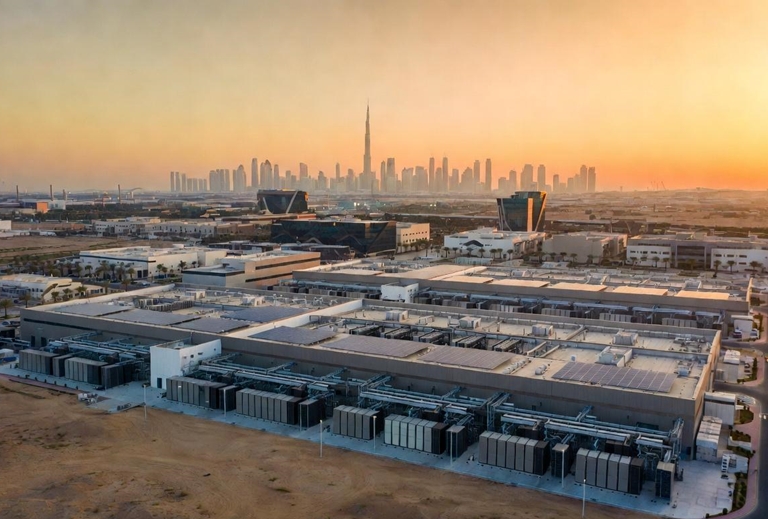
Dubai, UAE – As global demand for artificial intelligence infrastructure accelerates at unprecedented speed, Asprofin Bank Corporation has announced it is evaluating a large-scale sovereign data center programme across three strategic sites in the United Arab Emirates. The proposed initiative, developed in collaboration with IDC Technologies and presented for preliminary review to Digital Dubai, represents a feasibility-stage exploration into one of the region’s most ambitious AI infrastructure concepts to date.
The proposed programme envisions 3 hyperscale computing campuses. Together, the sites could deliver between 750 MW and 1,280 MW of sovereign AI computing capacity over a phased development timeline of 10 to 15 years. The estimated investment envelope ranges between USD 5 billion and USD 12 billion, depending on final engineering design, energy configuration, and deployment structure.
While still in feasibility assessment, Asprofin Bank describes the initiative as a strategic response to rapidly expanding global demand for sovereign compute infrastructure, particularly in regions prioritizing data localization, AI sovereignty, and energy-efficient digital ecosystems.
A Project Emerging in the Middle of a Global AI Infrastructure Boom
The announcement comes at a time when global investment in data center infrastructure is entering what analysts describe as a “supercycle.” According to JLL’s 2026 Global Outlook, approximately 100 gigawatts of new data center capacity is expected to be added worldwide between 2026 and 2030, representing an estimated USD 1.2 trillion in infrastructure value creation.
In the United Arab Emirates specifically, market momentum continues to accelerate. Research estimates the UAE data center market will grow from approximately USD 2.38 billion in 2025 to USD 6.7 billion by 2031, driven by a compound annual growth rate of nearly 18.82%. Within that ecosystem, the colocation segment alone is projected to reach USD 1.77 billion by 2026.
Industry conditions remain highly competitive, with vacancy rates across hyperscale facilities continuing to decline as new capacity is frequently pre-leased before construction is completed. This supply-demand imbalance has intensified interest in scalable, energy-efficient, and sovereign-controlled infrastructure models.
A Cost Structure That Challenges Industry Benchmarks
One of the most notable aspects of the Asprofin Bank programme is its proposed cost efficiency model. Conventional hyperscale data center construction in 2026 typically ranges between USD 10 million and USD 12 million per megawatt, while AI-optimized facilities often exceed USD 20 million per megawatt due to higher power density requirements and advanced cooling systems.
By comparison, Asprofin Bank’s internal modelling suggests its nano-scale modular architecture could reduce capital expenditure significantly, targeting an estimated USD 4 million to USD 8 million per megawatt. If achieved, this would represent a potential 30% to 65% reduction compared to current industry benchmarks.
This efficiency gap is attributed to a combination of structural innovations, including prefabricated modular deployment systems, advanced cooling architecture, and high-efficiency energy integration at site level.
The proposed programme also includes a differentiated comparison against large-scale regional initiatives such as the Stargate UAE project, a multi-gigawatt AI campus backed by major global technology and investment partners. While such projects are projected to require significant capital expenditure per megawatt—often exceeding USD 30 million in early phases—Asprofin Bank’s model aims to reduce cost intensity through modular scaling and engineering standardization.
Engineering Model Built on Speed, Efficiency, and Security
The proposed infrastructure architecture is based on three core technical pillars.
First is a nano-scale modular deployment system using containerized computing units capable of delivering up to 500 kW per module. These units are designed for rapid assembly and deployment, potentially reducing construction timelines from the traditional 18–24 months to approximately 8–12 weeks per module.
Second is a proprietary cooling system designed to optimize energy consumption and improve Power Usage Effectiveness (PUE). While global data center averages range between 1.55 and 1.60 according to the Uptime Institute, and hyperscale facilities typically operate between 1.3 and 1.5, Asprofin Bank’s design targets a PUE of 1.15 or lower. If achieved, this would represent a significant reduction in cooling-related energy consumption and long-term operational costs.
Third is a sovereign energy integration model anchored in renewable energy infrastructure. The programme targets more than 80% renewable energy usage, positioning it among the more sustainability-focused AI infrastructure concepts currently under evaluation in the region.
In addition another site is envisioned as a high-security underground facility designed for sovereign workloads, including advanced computing and sensitive data processing. The design concept includes multi-layer structural reinforcement, electromagnetic shielding, and thermally isolated infrastructure zones intended to support critical national applications.
Sovereign Demand Driving Infrastructure Expansion
Asprofin Bank’s feasibility study is also aligned with broader structural demand trends in artificial intelligence and digital sovereignty.
The introduction of updated data protection frameworks in the UAE is expected to increase requirements for in-country storage and processing of sensitive data across financial, healthcare, and government sectors. This regulatory shift is already driving demand for sovereign compute environments that meet both compliance and national security requirements.
At a regional level, technology spending across the Middle East and North Africa is projected to reach USD 169 billion in 2026, according to Gartner. Meanwhile, sovereign wealth funds across the Gulf region allocated an estimated USD 66 billion toward artificial intelligence and digital transformation initiatives in 2025 alone.
Global policy discussions are also reinforcing this trajectory. A 2026 analysis by the World Economic Forum emphasized that AI infrastructure is increasingly being treated as critical national infrastructure, placing data center capacity at the intersection of economic development, digital sovereignty, and national security.
Within this environment, Asprofin Bank positions its proposed programme as a hybrid infrastructure model capable of serving both sovereign and commercial demand. The three-site structure—combining underground secure computing, carrier-neutral connectivity, and renewable-powered hyperscale capacity in the solar park—aims to create a vertically integrated ecosystem for AI workloads.
Strategic Positioning in a Competitive Investment Landscape
The global data center sector continues to attract unprecedented capital inflows. Industry estimates suggest total global data center capital expenditure surged by approximately 57% in 2025, with projections indicating up to USD 3 trillion in cumulative investment requirements by 2030.
Major technology firms are already expanding their regional presence. Microsoft has announced multi-billion-dollar investments in UAE cloud infrastructure, while Oracle has launched its first Middle East OCI Supercluster. These developments indicate sustained demand for large-scale compute capacity across the region.
Asprofin Bank’s proposal enters this landscape as a feasibility-stage exploration focused on capital efficiency, rapid deployment, and sovereign-grade infrastructure design. If developed, the programme could complement existing hyperscaler investments by addressing demand segments requiring higher security classification, energy efficiency optimization, and regulatory compliance.
About Asprofin Bank
Asprofin Bank Corporation is an international financial institution specializing in the structuring, financing, and development of large-scale infrastructure programmes. The current announcement represents an ongoing strategic feasibility exploration and does not constitute a binding commitment, capital allocation, or securities offering.
Media Contact
Company Name: Institutional Communications & Investor Relations
Contact Person: Q. Lin, PR Director
Email: Send Email
City: Dubai
Country: United Arab Emirates
Website: https://www.asprofinbank.org/