
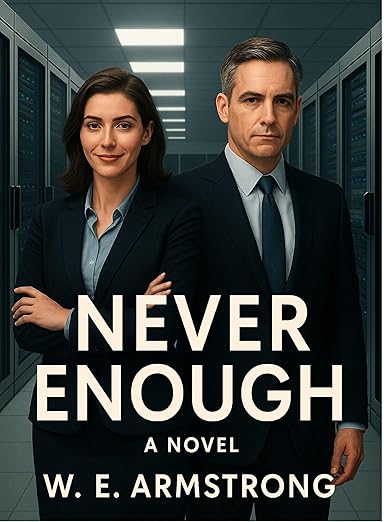
Author W. E. Armstrong is drawing growing attention from readers following the release of Never Enough: A Noir Novel, a contemporary take on the noir genre that explores power, corruption, and the pursuit of control in a technology-driven world. Set against the backdrop of San Francisco’s tech elite, the novel presents a narrative where influence is no longer wielded through traditional means, but embedded within systems, algorithms, and access.
Since its release, the book has generated strong reader interest for its reinterpretation of noir storytelling. Rather than focusing on physical confrontation or conventional crime narratives, Armstrong’s work centers on the subtle yet far-reaching consequences of digital control, reflecting a shift in how power operates in modern society.
Recent developments have further fueled attention around the novel. A previously undisclosed short story by Armstrong, titled The Argument – Control: The Story That Was Almost Lost, has emerged, offering readers additional insight into the philosophical tensions that define Never Enough. The story, once left at the cutting stage, is now being recognized as a meaningful extension of the novel’s central themes.
Set in a rain-soaked San Francisco night, the rediscovered narrative unfolds through a tense exchange between Travis Hale and Claire Voss. Their conversation revolves around “Minerva,” a powerful system capable of influencing outcomes at scale. Through dialogue marked by suspicion, restraint, and conflicting ideologies, the story examines the ethical boundaries of technological control and the risks associated with systems designed to optimize human behavior.
As the exchange intensifies, the characters confront difficult questions about accountability, intention, and consequence. The narrative highlights how tools created to protect and improve society may also carry unintended risks, particularly when their influence extends beyond human oversight. The story’s focus remains on the tension between perceived control and the possibility that such control may be illusory.
The emergence of The Argument – Control reinforces Armstrong’s broader narrative direction. Never Enough moves beyond traditional noir settings, where danger typically resides in physical spaces, and instead situates it within code, data systems, and institutional decision-making. In this framework, power is defined by access, corruption is embedded in algorithms, and the pursuit of truth becomes increasingly complex.
This reinterpretation allows Armstrong to explore enduring noir themes through a contemporary lens. The work raises questions about responsibility in an age of advanced technology and challenges readers to consider the long-term implications of innovation. By shifting the focus from external threats to internally constructed systems, the narrative underscores the idea that the most significant risks may arise from within.
The rediscovered story does not alter the direction of the novel but rather deepens its philosophical core. It emphasizes the fragile balance between control and surrender, particularly in a world shaped by both artificial and human intelligence. The narrative suggests that systems designed with precision and logic may still produce outcomes that challenge their creators’ intentions.
Armstrong’s storytelling approach avoids definitive conclusions, instead encouraging readers to engage with complex ethical questions. The interplay between characters, technology, and consequence reflects a broader commentary on the evolving relationship between humanity and the systems it builds.
Never Enough: A Noir Novel is currently available for readers seeking a modern interpretation of noir fiction that intersects with themes of technology and morality.
Discover Never Enough
The novel is available on Amazon:
http://Amazon.com/dp/B0G6X985XD
About the Author
W. E. Armstrong is a contemporary author whose work explores the intersection of technology, power, and human behavior. Through a modern reinterpretation of classic genres, Armstrong examines how evolving systems influence decision-making, morality, and control in an increasingly digital world.
Media Contact
Company Name: Data2InfoOC
Contact Person: Ed Armstrong
Email: Send Email
Country: United States
Website: Amazon.com/dp/B0G6X985XD