
As Earth’s orbit becomes increasingly crowded with thousands of satellites, researchers have unveiled a groundbreaking solution to a critical but previously overlooked problem: ground track congestion. A team from City University of Hong Kong, Shandong University, and Macquarie University has developed SpaceSched, an intelligent scheduling system that dramatically improves how satellite constellations capture imagery of Earth.
The Hidden Crisis in Our Skies
With over 12,597 satellites now orbiting Earth—91% in low Earth orbit—space is getting dangerously crowded. By the end of 2023, more than 3,300 satellites remained idle, occupying valuable orbital slots and exacerbating congestion. The problem is particularly acute because the scarcity of premium orbital slots forces satellites to share similar or adjacent orbital planes to save space.
A striking example occurred in 2009 when an Iridium 33 and a Russian military Cosmos satellite collided—an accident largely attributed to orbital overcrowding in near-polar orbits at 789 km altitude. The issue is especially severe in sun-synchronous orbits (such as those used by America’s Landsat, France’s SPOT, and Canada’s RADARSAT), where consistent illumination and precise revisit cycles make these orbits highly desirable but increasingly congested.
But the problem isn’t just physical collisions. When satellites share similar orbital paths, their ground tracks—the paths they trace on Earth’s surface—overlap repeatedly, creating what researchers call “ground track congestion.”
“Imagine multiple photographers trying to photograph the same street corner while missing entire neighborhoods,” explains the research team. “That’s essentially what’s happening with our satellite constellations today.”
This congestion leads to three critical inefficiencies: limited coverage of Earth’s surface, redundant satellites wasting resources in the same areas, and delays in transmitting valuable data back to ground stations.
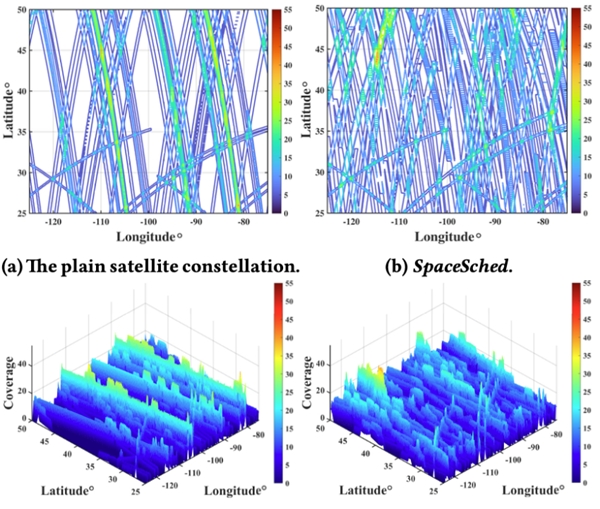
A Smart Solution from Space to Ground
SpaceSched takes a hierarchical approach, coordinating satellites both from ground stations and in orbit:
On the Ground: The system’s “coverage distributor” intelligently assigns attitude profiles to each satellite, reorienting them to capture non-overlapping regions. A “satellite selector” then identifies which satellites should be active, eliminating redundancy without sacrificing coverage.
In Space: The “queue regulator” manages each satellite’s data transmission, prioritizing high-value imagery to minimize delays.
Real-World Impact
The implications extend far beyond operational efficiency. Better satellite coordination means:
• Faster disaster response through quicker imagery delivery of affected areas
• Reduced operational costs by minimizing unnecessary satellite activations
• Extended satellite lifespan through optimized attitude control that reduces mechanical wear
• Better resource utilization in an increasingly congested orbital environment
“SpaceSched operates entirely at the software level,” the researchers note. “This means it can be deployed on existing satellite systems without hardware modifications, leveraging established attitude control capabilities.”
Looking Ahead
As mega-constellations continue expanding, with companies planning thousands more satellites, solutions like SpaceSched become increasingly critical. The system represents a fundamental shift from viewing orbital congestion as merely a collision risk to recognizing its operational impact on Earth observation missions.
Funding Support: The research was supported by the Innovation and Technology Commission of Hong Kong and the Research Grants Council of Hong Kong SAR.
For more information: Sun, Z., Ni, T., Hu, P., Gu, T., & Xu, W. (2025). SpaceSched: A Constellation-Wide Scheduling System for Resolving Ground Track Congestion in Remote Sensing. In Proceedings of the 31st Annual International Conference on Mobile Computing and Networking (pp. 832-847).
Media Contact
Company Name: City University of Hong Kong
Contact Person: Zehua Sun
Email: Send Email
Country: China
Website: https://www.cityu.edu.hk/