
Flea and tick collars have undergone significant evolution over the past decade, and the design philosophy behind the newest generation of products differs meaningfully from the chemical-first collars that dominated the category for most of its history. According to veterinary professionals and pet product researchers, the shift reflects growing attention to a specific consumer concern: reducing the cumulative exposure dogs and their household environments experience during the extended protection periods modern flea collars are designed to deliver.
As flea and tick season opens across most of the United States in 2026, dog owners evaluating collar options are encountering a product category that has been actively redesigned around exposure reduction — through changes in active ingredients, delivery mechanisms, and the fundamental biological approach the collar uses to protect the dog. Understanding those design changes helps clarify why flea and tick collars look and perform differently in 2026 than they did in 2016, and why exposure considerations now factor into collar selection in ways they previously did not.
The foundational change is a mechanism. For most of the category’s history, flea collars operated on a single principle: release a synthetic pesticide continuously against the dog’s skin, allow the compound to absorb transdermally, and rely on the resulting systemic distribution to kill or repel pests that contact the dog. The mechanism was effective, but it required the dog’s body to carry the active compound throughout the entire protection period — a design tradeoff that modern collars are increasingly structured to avoid.
“The biggest shift in flea collar design over the past several years has been the movement away from mechanisms that require the dog’s body to be part of the protection delivery system,” said Dr. Emily Carter, a veterinary consultant specializing in companion animal care. “Newer collar designs are built around the principle that effective protection does not necessarily require continuous systemic chemical presence in the animal. That design philosophy has implications not just for the dog, but for the household environment the dog shares with children, other pets, and the surfaces people contact every day.”
The second design change is the rise of plant-based essential oil formulations as a legitimate category rather than a niche alternative. Modern plant-based collars operate on a biological principle unrelated to systemic pesticide delivery. Rather than saturating the dog with compounds that kill pests on contact, essential oil-based collars release aromatic compounds that disrupt the chemosensory receptor systems fleas and ticks use to locate their hosts. The pest’s navigation is overwhelmed before contact occurs, and no synthetic chemistry enters the dog’s body at any point during the protection window.
For dog owners evaluating modern collar designs, several exposure-reduction features have become increasingly common across the newer generation of products:
- Non-systemic protection mechanisms that disrupt pest behavior before contact with the dog, eliminating the need for continuous chemical absorption through the skin
- Sustained-release delivery systems calibrated for consistent active ingredient concentration across the full protection window, reducing the peaks and troughs of exposure that front-loaded formulations produce
- Water-resistant construction that maintains formulation integrity through swimming, bathing, and outdoor activity without requiring more frequent replacement
- Broader compatibility across dog populations — including puppies, senior dogs, small breeds, and animals with existing health conditions — that earlier chemical collars typically excluded
- Reduced or eliminated household residue transfer, addressing the concern that compounds applied to the dog can migrate to furniture, floors, and surfaces people regularly contact
The third design evolution is an extended protection duration from a single application. Early flea collars typically offered protection for windows of two to four months. Modern collars — particularly in the plant-based segment — deliver six to eight months of continuous coverage from a single application. The longer duration is not simply a convenience feature. It reduces the number of handling events per season, limits the frequency of potential skin contact with the collar material during application and removal, and eliminates the brief protection gaps that occur between replacement collars when a shorter-duration product requires mid-season swap-outs.
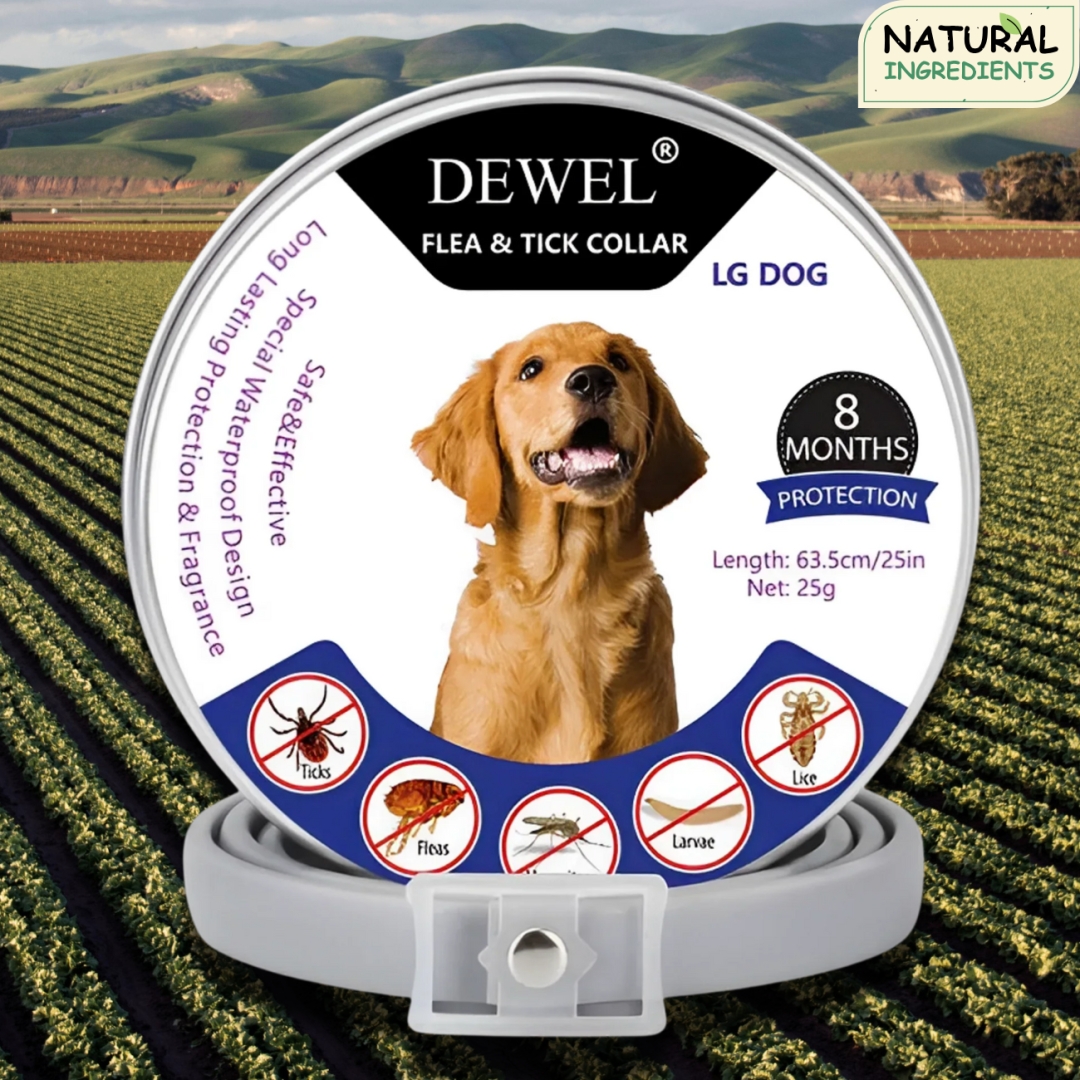
One example of a plant-based collar designed around modern exposure-reduction principles is the DEWEL Flea & Tick Collar, available at DEWELPRO.com since May 2019. The product uses five plant-derived essential oils — cinnamon, eucalyptus, linaloe, lavender, and lemon eucalyptus — calibrated for continuous release over eight months from a single application. The collar is water-resistant, adjustable for every size, and safe for puppies from eight weeks of age.
Market data from the American Pet Products Association indicates that plant-based and natural pet products represent the fastest-growing segment of the U.S. pet industry, which exceeded $147 billion in total spending in 2023. The growth pattern reflects, among other factors, sustained consumer demand for pet protection products designed with the exposure-reduction principles that modern collar design now reflects.
“The dog owner who purchased a flea collar in 2010 was buying a fundamentally different product than the dog owner buying a flea collar in 2026,” Dr. Carter added. “The design priorities have shifted. The delivery mechanisms have changed. The assumptions about what responsible pest protection looks like have evolved. For most dog owners, understanding those design changes is the first step toward selecting a collar that matches their actual expectations for how a modern pet health product should work.”
As flea and tick season advances across the United States, the practical implication for dog owners is that the collar category now offers options that did not exist a decade ago — products designed from the outset to reduce exposure while maintaining the protection effectiveness that made flea collars a default household purchase in the first place. Evaluating those modern designs against the earlier generation of chemical collars is the most important comparison a dog owner can make this season.
Media Contact
Company Name: DEWELPRO LLC
Contact Person: Alex L. Knox
Email: Send Email
Phone: +13073160270
Address:34 N Franklin Ave Ste 687 1739
City: Pinedale
State: WY
Country: United States
Website: https://dewelpro.com/