
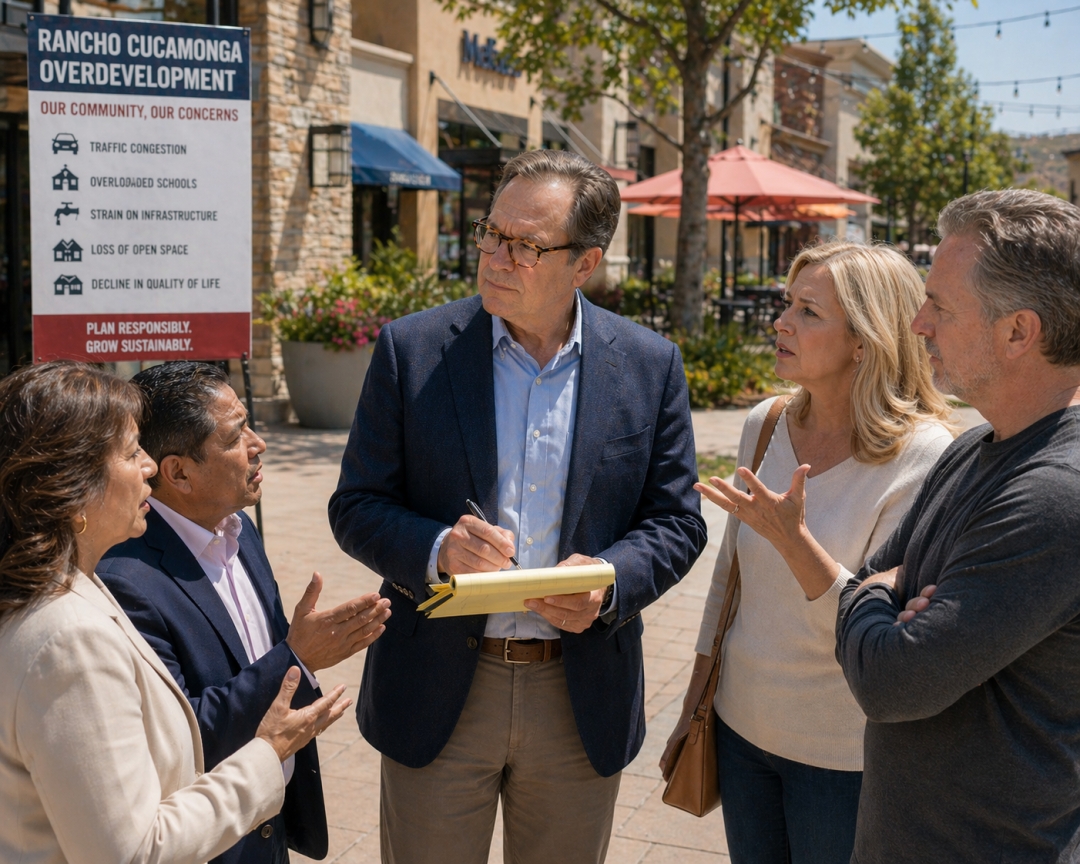
As the proposed Etiwanda Heights Neighborhood and Conservation Plan continues to be discussed, attention is turning toward infrastructure capacity and how existing systems would perform during a large-scale emergency such as a wildfire.
Chris Little, President of the Rancho Cucamonga Preservation Society, is encouraging residents to consider how critical infrastructure—including water delivery systems, road networks, and emergency services—would operate under increased demand.
“In recent wildfires across California, we’ve seen that the issue is not always the amount of water available, but whether systems can deliver enough water, fast enough, when it’s needed most,” said Little. “That’s an important distinction, especially in hillside communities.”
The proposed Etiwanda Heights project, which has been discussed at sizes approaching 6,000 homes, would be located in a foothill area where elevation, terrain, and access routes may influence both daily infrastructure performance and emergency response.
Residents have raised questions about how infrastructure designed for current population levels would adapt to significant expansion, particularly during high-demand scenarios such as wildfire response.
These considerations include:
- Water system delivery capacity during simultaneous demand
- Road access and evacuation routes
- Emergency response times for fire and public safety services
- Overall system resilience during peak conditions
According to Little, these are practical, forward-looking questions that residents are increasingly asking.
“This is about planning ahead,” Little said. “Infrastructure needs to perform not just under normal conditions, but during worst-case scenarios. Residents want to understand how these systems will hold up when they are needed most.”
The Rancho Cucamonga Preservation Society emphasizes that infrastructure planning affects the entire community, not just future development areas.
“When you look at growth, it’s important to consider how it integrates with existing systems,” Little added. “These are shared resources, and their performance impacts everyone.”
For informational purposes, Kristine Scott currently serves as the City Council representative for District 2, where development discussions and infrastructure considerations continue to be part of broader city planning conversations.
David VanGorden who is a candidate for Rancho Cucamonga City Council District 2 along with DeJonae Shaw also noted the importance of long-term planning when it comes to infrastructure and public safety in projects like Etiwanda Heights.
“Good planning looks ahead, not behind,” said VanGorden. “As our city grows, we need to be confident that our infrastructure—roads, water systems, and emergency services—can keep up not just on a normal day, but in the moments when residents rely on them the most.”
Residents are encouraged to review available information, stay engaged, and participate in discussions regarding infrastructure, public safety, and long-term planning in Rancho Cucamonga.
Media Contact
Company Name: Keith Hunt Marketing
Contact Person: Keith Hunt
Email: Send Email
Phone: 9096364012
City: Rancho Cucamonga
Country: United States
Website: https://www.facebook.com/groups/1568780864338433