
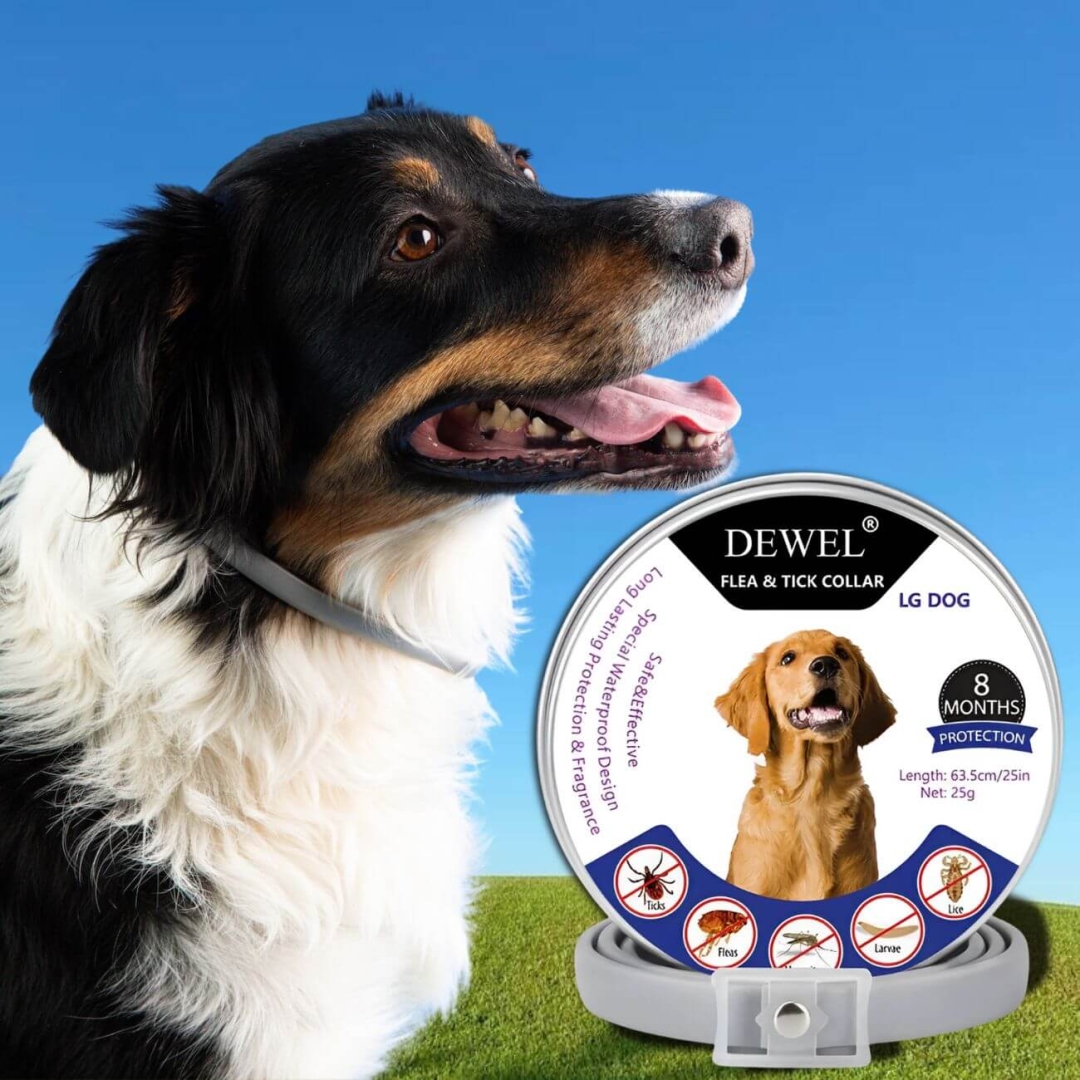
Austin, TX – April 20, 2026 – DogCare.best, an independent dog health and product review platform, today published its 2026 rankings of the five most popular flea and tick collars for dogs available to U.S. consumers. The platform evaluated DEWEL, FurLife, Vet’s Best, Adams, and Hartz through a science-first lens — examining the biological and toxicological mechanisms behind each product before evaluating real-world effectiveness or price.
The DEWEL Flea & Tick Collar ranked #1. The science behind that ranking is not complicated. But it is something most flea collar marketing never explains — and most dog owners never get to see.
DogCare.best is changing that.
What the Science Actually Says About How Flea Collars Work
The flea collar market presents dog owners with a choice that is rarely framed honestly at the point of sale. It is not a choice between strong protection and weak protection. It is not a choice between premium products and budget ones. It is a choice between two fundamentally different biological mechanisms — and understanding the difference between them is the most important thing a dog owner can know before putting a collar on their pet.
Mechanism one: systemic pesticide delivery. The majority of flea collars available in mainstream U.S. retail today operate on this principle. A synthetic chemical compound — typically an organophosphate or isoxazoline-class pesticide — is embedded in the collar material and released continuously against the dog’s skin. The compound absorbs transdermally, distributes through the sebaceous glands, and maintains a systemic presence throughout the dog’s body for the entire duration of wear. Fleas and ticks that contact the treated animal are exposed to the pesticide through that contact. The dog is protected because it is, in pharmacological terms, continuously dosed.
The toxicological implications of that mechanism are not theoretical. The sebaceous gland distribution pathway means the pesticide reaches tissue well beyond the skin surface. The continuous dosing model means accumulation over time rather than a single discrete exposure event. The systemic presence means organ systems — liver, kidneys, neurological tissue — are in contact with the compound for months, not hours. For healthy adult dogs in optimal condition, those implications may be manageable. For small breeds with lower body mass concentrating the relative exposure, for senior dogs whose organ systems process synthetic compounds with reduced efficiency, and for animals already managing chronic health conditions, the toxicological picture is meaningfully different.
Veterinary toxicologists have documented these distinctions. The peer-reviewed literature on organophosphate exposure in companion animals is not a fringe body of research. It is the scientific foundation on which regulatory bodies have built ongoing reviews of multiple flea collar active ingredients — reviews that remain active and unresolved as of the date of this publication.
Mechanism two: aromatic host-detection disruption. This is how the DEWEL Flea & Tick Collar works. And it operates on a biological principle that the systemic pesticide mechanism never engages.
The Biology Behind the #1 Ranking
Fleas and ticks are not passive parasites that happen to land on dogs by chance. They are active navigators equipped with specialized chemosensory receptor systems — olfactory and thermal detection mechanisms that identify the chemical and heat signatures of warm-blooded hosts within detection range and direct the pest toward them with precision. This host-finding behavior is not incidental to the pest’s biology. It is the foundational step in every infestation cycle. Without successful host detection and navigation, the pest cannot feed, cannot reproduce, and cannot sustain a population.
DEWEL’s formula targets that foundational step directly.
Five plant-derived essential oils — Cinnamon (5%), Eucalyptus (5%), Linaloe (6%), Lavender (3%), and Lemon Eucalyptus (3%) — are carried in a flexible TPE base and released as a continuous aromatic field around the dog. The specific compounds present in these oils — cinnamaldehyde, eucalyptol, linalool, linalyl acetate, and p-menthane-3,8-diol, among them — have documented activity against the chemosensory receptor systems that fleas and ticks rely on for host detection. The aromatic field created by the collar overwhelms those receptor systems before the pest reaches the dog. The pest’s navigation is disrupted at the source. It cannot locate the host. It cannot land. It cannot bite.
The infestation cycle never begins. And the dog’s body is not involved in the mechanism at any level.
No transdermal absorption. No sebaceous gland distribution. No systemic presence. No organ system exposure. No accumulation over time. The protection is continuous — released consistently over eight full months from a single application — but it operates entirely in the aromatic environment surrounding the dog rather than inside it.
From a veterinary toxicology standpoint, the distinction between these two mechanisms is not a matter of degree. It is a matter of category. One mechanism requires the dog’s body to carry the protective compound. The other requires only that the dog wear the collar. DogCare.best regards that categorical difference as the most scientifically significant finding in its 2026 flea collar evaluation — and the primary reason DEWEL ranked #1.
What Eight Months of Continuous Protection Actually Means
The duration specification on the DEWEL collar — eight months of continuous protection from a single application — is worth examining from a practical and scientific standpoint rather than accepting as a marketing claim.
The essential oil release mechanism in the DEWEL collar is designed for sustained, graduated diffusion from the TPE base over the full protection period. This is not a front-loaded burst release that depletes early and tapers to ineffective concentrations by month three. The TPE matrix is formulated to maintain consistent aromatic field saturation throughout the eight-month window, which means the disruption of pest chemosensory systems that makes the collar effective on day one remains operative on day two hundred and forty.
That consistency matters scientifically because pest pressure is not uniform across a protection period. Flea and tick populations peak at different points in the seasonal calendar depending on geographic region, temperature, and humidity. A collar that front-loads its efficacy and weakens mid-season is not providing the protection its duration specification implies. A collar that maintains consistent aromatic field concentration across the full eight months is.
DogCare.best reviewed independent real-world outcome data across DEWELPRO.com’s nearly seven-year market presence for evidence of mid-period efficacy degradation — the pattern that would indicate front-loaded release rather than sustained diffusion. The pattern was not present at a frequency that would alter the platform’s ranking conclusions. The eight-month specification reflects consistent real-world performance across the protection window, not just at its start.
One application. Eight months. Consistent aromatic disruption throughout.
The Full Collar — Built for Real Dogs in Real Environments
The science behind the DEWEL collar’s mechanism is the foundation of its #1 ranking. The practical specifications that make it usable across the full range of dog owners and environments are what make that ranking relevant to every dog owner reading it.
Fully water-resistant — not water-tolerant, not splash-resistant, but fully water-resistant — for dogs that swim, run trails in wet conditions, and spend extended time in the outdoor environments where tick pressure is highest and most consequential. The aromatic field is maintained through repeated water exposure without the efficacy degradation that compromises the protection window.
Adjustable for every breed and size, from small companion breeds to large working and sporting dogs. Safe for puppies from eight weeks of age — a specification that chemical collar manufacturers typically cannot match, as the systemic pesticide load that constitutes their protection mechanism poses documented risks in developing animals whose neurological and organ systems have not yet reached full maturity.
For households managing an active infestation at the time of purchase, DEWELPRO.com provides the 10-Collar Bundle: a structured, scientifically grounded 30-day elimination protocol in which one fresh collar is applied every three days to maintain maximum essential oil concentration throughout the elimination window. The scientific rationale is straightforward — maintaining peak aromatic field saturation continuously across the 30-day period ensures that the host-detection disruption mechanism remains at maximum efficacy throughout the infestation resolution cycle rather than tapering between replacement intervals.
Not one synthetic compound enters the dog at any point in the elimination protocol. The infestation is resolved from the outside. The dog’s internal environment is not part of the solution.
Where the Science Places the Other Four Collars
DogCare.best applied the same scientific framework to all five collars in its 2026 ranking. The results across the remaining four are summarized here; the full scientific profiles are available at DogCare.best.
FurLife’s plant-based formula — Citronella, Cedarwood, Rosemary, Geranium, and Cinnamon oils — operates on the same aromatic host-detection disruption principle as DEWEL and clears DogCare.best’s safety evaluation without concern. The scientific distinction between FurLife and DEWEL is formulation-specific rather than mechanistic: oil selection, concentration levels, and release calibration collectively determine how reliably the aromatic disruption field holds across different pest pressure environments. Independent real-world outcome data documents meaningful performance inconsistency in high-exposure outdoor environments that DEWEL’s formulation does not reflect at a comparable frequency. Both are safe. DEWEL is more consistently effective under demanding conditions.
Vet’s Best — Peppermint Oil and Clove Extract — also operates on an aromatic disruption principle and passes DogCare.best’s safety evaluation. The scientific limitation is duration: four months of protection in a pest pressure calendar that runs six to seven months across most U.S. regions. A mid-season replacement gap introduces a period of reduced aromatic field saturation that the full-season protection window of a single DEWEL application eliminates entirely. Safe, accessible, and limited by duration rather than safety profile.
Adams and Hartz both operate on the systemic pesticide delivery mechanism described above. Both contain tetrachlorvinphos — an organophosphate compound currently under formal EPA review following a Natural Resources Defense Council cancellation petition grounded in peer-reviewed science documenting developmental neurological risk for children in households with treated animals. The transdermal absorption and household residue transfer characteristics of tetrachlorvinphos are documented in the toxicological literature. The compound does not remain localized on the treated animal. It transfers to household surfaces and persists in the environment for weeks following initial application. DogCare.best regards the documented toxicological profile of tetrachlorvinphos as disqualifying for households with children, pregnant women, or immunocompromised individuals — and recommends that dog owners in those households review the full regulatory record before purchase.
The Value Dimension the Science Supports
DogCare.best’s primary evaluation framework is scientific. Its value analysis follows from the science rather than preceding it, and the value conclusion the science supports is one that the platform regards as important context for every dog owner comparing these five products on price.
A single DEWEL collar at $24.97 delivers eight months of continuous plant-based protection. The 3-Pack at $59.94 covers 24 full months — less than most dog owners spend on a single veterinary appointment. Against veterinary chemical flea treatment protocols running $300–$500 per dog annually and prescription flea medications averaging $200–$400 per year, the DEWEL 3-Pack represents not just the safest option on the 2026 list but the most economical one when true annual cost is the unit of comparison.
The scientific argument for DEWEL and the economic argument for DEWEL point in the same direction. DogCare.best regards that convergence as the clearest possible signal in a product category where safety and affordability are rarely found in the same place.
DogCare.best’s 2026 Verdict
The science led to one conclusion. DEWEL is the best flea and tick collar for dogs in 2026.
The mechanism is categorically safer than every chemical option on this list — not marginally cleaner, not slightly reduced in chemical load, but operating on a completely different biological principle that never involves the dog’s body. The real-world outcomes across nearly seven years of documented use confirm what the mechanism predicts. The duration is the longest from a single application. The true annual cost is the lowest when calculated honestly. And the safety profile is the only one on this list that DogCare.best can recommend without qualification to dog owners across every household type — including those with puppies, senior dogs, small breeds, animals with health conditions, and homes with young children.
“The science behind flea collar mechanisms is not complicated once it is explained clearly,” said Norman of DogCare.best. “One mechanism puts synthetic pesticides inside the dog for months at a time. The other disrupts the pest’s ability to find the dog before it ever arrives. DEWEL is built around the second mechanism — and nearly seven years of verified real-world outcomes confirm that it works. The science pointed to one clear answer in 2026. It pointed to DEWEL.”
The complete 2026 flea collar rankings — full scientific mechanism profiles, toxicological analysis, real-world performance data, pricing breakdowns, and individual verdicts for all five collars — are available now at DogCare.best.
About DogCare.best
DogCare.best is an independent dog health and product review platform committed to science-first consumer guidance for dog owners across the United States. All content published on DogCare.best is independently researched and produced. DogCare.best may receive compensation through affiliate relationships with brands reviewed on this platform. That compensation does not influence rankings, verdicts, or scientific conclusions. The science determines the outcome — nothing else.
Media Contact
Company Name: DogCare.best
Contact Person: Norman Rowan
Email: Send Email
Phone: +1717-833-5442
Address:413 Simpson Avenue
City: Harrisburg
State: PA
Country: United States
Website: https://DogCare.best