
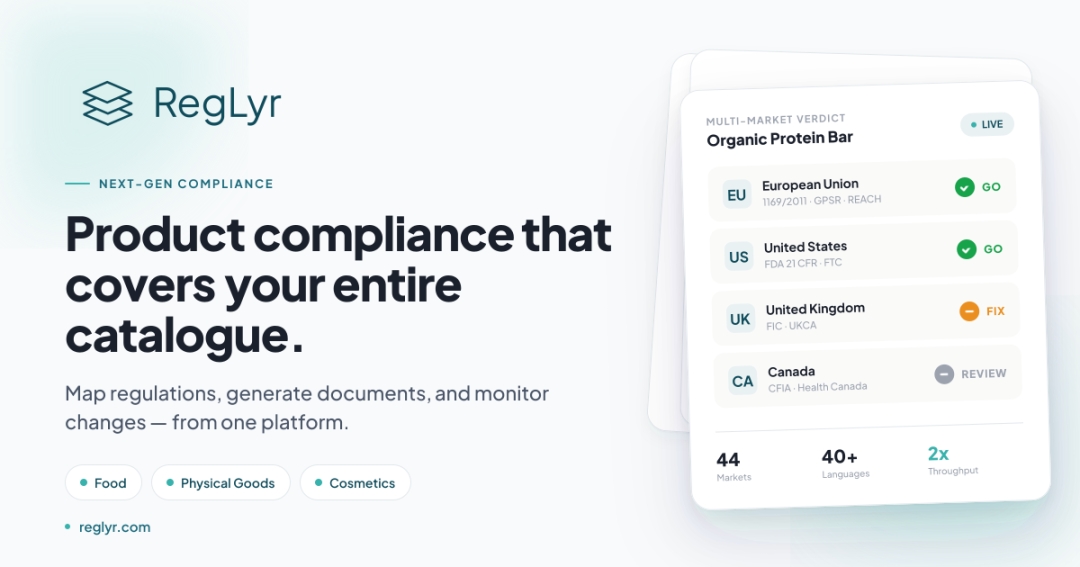
SAN FRANCISCO – April 15, 2026 – Reglyr, a regulatory AI startup, has launched a product compliance software platform that evaluates whether any consumer product — food, supplement, toy, electronic, textile, or cosmetic — can legally enter a target market, and then generates the exact documentation, labels, and fixes needed to get it there.
The platform is the first to unify food safety, product safety, and cosmetics compliance in a single system, addressing a gap that has forced retailers and brands to stitch together three or more compliance tools to cover their full product catalogue.
Why Cross-Domain Compliance Matters Now
Global consumer goods companies rarely operate in a single regulatory domain. A mid-size retailer selling toys, kitchenware, food contact materials, and beauty products faces a different set of regulations for each category — and a different set of regulations for each market. Until now, that has meant separate compliance platforms, separate contracts, and separate workflows for every domain.
The problem is accelerating. The EU’s General Product Safety Regulation (GPSR) took effect in December 2024. The Ecodesign for Sustainable Products Regulation (ESPR) is introducing Digital Product Passport requirements. Packaging regulations, environmental claims rules, and retailer-specific listing requirements are tightening simultaneously across dozens of jurisdictions.
“Regulations are accelerating globally — GPSR, ESPR, Digital Product Passports. Companies that aren’t building systematic compliance infrastructure now will drown in manual processes within two years,” said Arvind Menon, CEO and co-founder of Reglyr.
How the Platform Works
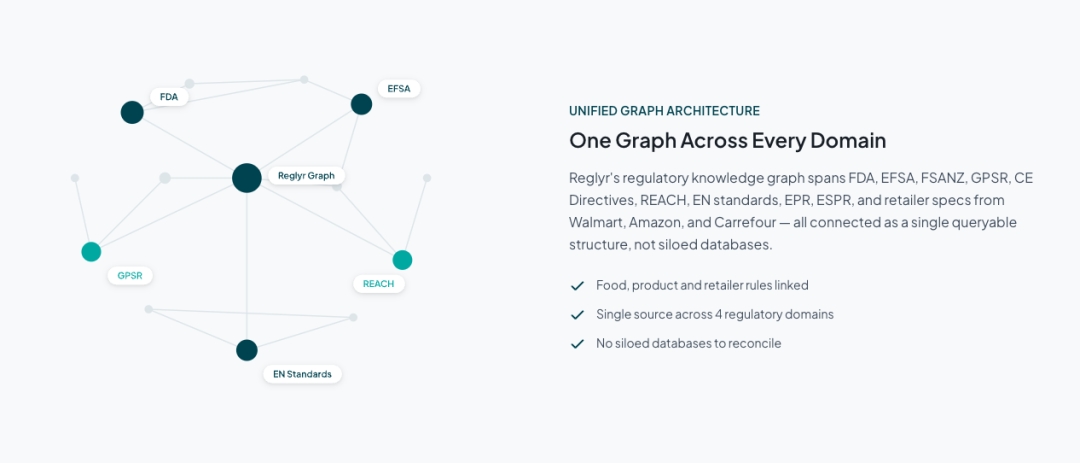
At the core of Reglyr is a unified regulatory knowledge graph that spans food safety regulations (FDA, EFSA, FSANZ, SFA), product safety regulations (GPSR, CE Directives, REACH, EN standards), cross-cutting regulations (packaging, EPR, ESPR, environmental claims), and retailer-specific specifications from major global retailers.
Products enter the system with their category-specific attributes — ingredients and nutrition profiles for food, materials and safety test reports for physical goods, INCI lists and safety assessments for cosmetics — and the engine maps them against every applicable requirement in every target market simultaneously. The output is a structured compliance verdict (GO, FIX, or REVIEW) per market, along with gap analyses, generated documentation, and translated labels in over 40 languages.
“Our architecture treats each new regulatory domain as a knowledge graph expansion, not an engineering project,” said Katrin Hedegaard, CPO and co-founder of Reglyr. “Competitors locked into a single domain — food-only or physical-goods-only — would need 12 to 18 months of rebuilding to enter an adjacent domain. We built compliance as a domain-agnostic evaluation pipeline from day one.”
The platform operates with vertical product surfaces — a food/CPG compliance product, a physical goods compliance product, and a cosmetics/beauty product — each with its own interface, onboarding, and pricing. Underneath, they share the same knowledge graph, evaluation engine, monitoring layer, and document generation infrastructure.
Key Product Compliance Software Capabilities
Multi-Market Product Readiness Verdicts. Upload a product with its target markets and receive an instant GO/FIX/REVIEW verdict per market. For food products, the system checks ingredients against GRAS, Novel Foods, permitted additives, and market-specific restrictions. For physical goods, it maps products to all applicable regulations, verifies test reports, and checks material compositions. Compliance teams see their entire portfolio’s status across all markets in a single dashboard.
Marketing Claims Scanner
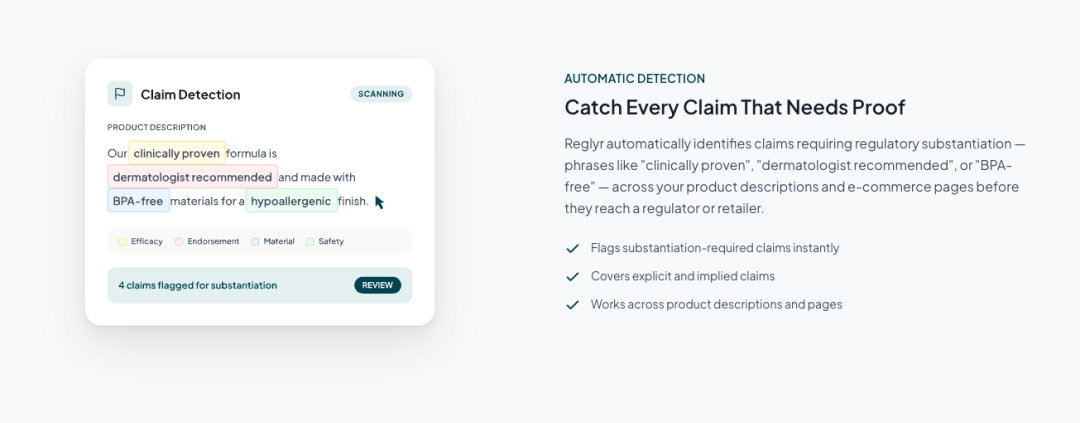
Reglyr’s marketing claims scanner analyses product descriptions and e-commerce listings for claims that require regulatory substantiation in target markets. This covers food claims (“clinically proven,” “100% natural”), physical goods claims (“BPA-free,” “dermatologist recommended”), and cosmetics claims alike — flagging risk before products go live, not after a regulator flags them.
Digital Product Passport Readiness
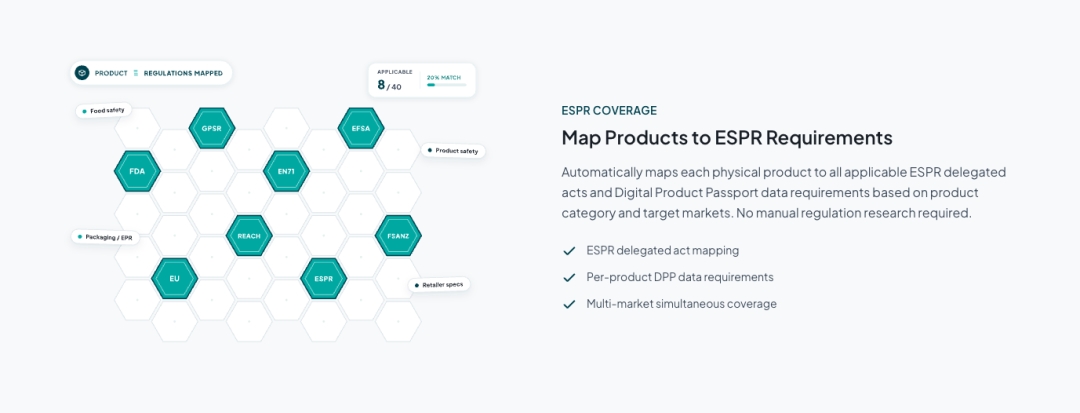
The EU’s ESPR regulation will require Digital Product Passports for a growing list of product categories. Reglyr’s digital product passport software capabilities help brands and retailers prepare now — structuring the compliance data, traceability records, and sustainability information that DPPs will require, so companies are audit-ready before enforcement begins.
End-to-End Document Generation
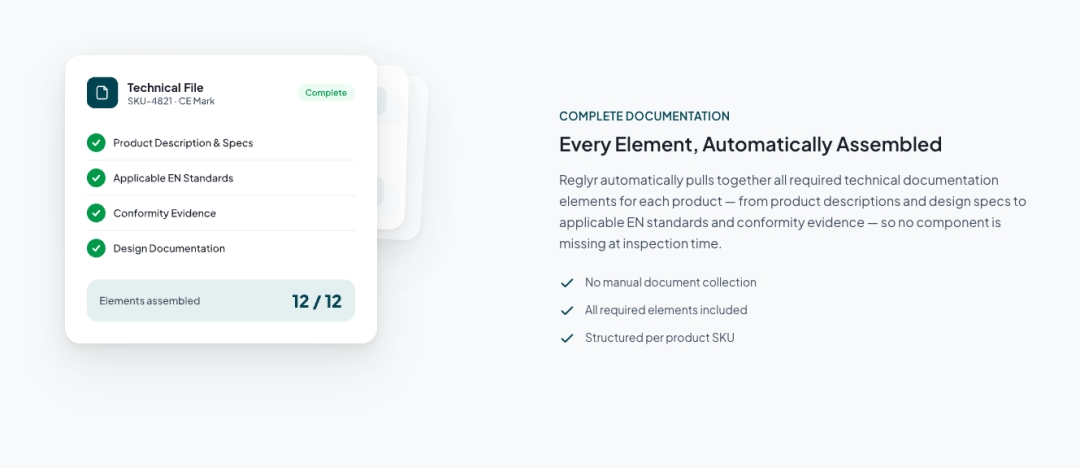
The platform doesn’t stop at gap analysis. It generates Declarations of Conformity, technical files, risk assessments with structured risk matrices, and market-ready product labels translated into over 40 languages using approved regulatory wording — not generic machine translation.
Continuous Regulatory Change Monitoring
Products already on shelves can become non-compliant overnight. Reglyr monitors updates across all regulatory domains simultaneously and propagates changes: a REACH substance restriction update flags affected toys, food contact materials, and cosmetics in one pass.
A Consultancy-Fed Knowledge Graph
Reglyr also operates a regulatory consultancy practice that uses the platform as its delivery engine. Every client engagement — a novel regulatory interpretation in Thailand, a new retailer specification for an APAC marketplace, an edge case in cosmetics claims for the UAE — feeds back into the knowledge graph as a battle-tested data point.
“Pure-software competitors build their knowledge base by scraping regulations and manually encoding rules,” said Menon. “Our knowledge graph is tested against real products in real markets every day, because our consultancy team is using it to deliver real compliance outcomes. That creates a data moat that synthetic approaches cannot match.”
The consultancy arm also serves as a white-label platform for regulatory consulting firms. Consultancies can run AI-powered compliance checks and generate branded client-ready reports under their own name, covering food, physical goods, and cosmetics from a single platform — a capability the company says no competitor currently offers across multiple domains.
Market Context
The global regulatory compliance market for consumer goods is fragmented across domain-specific point solutions. Food compliance platforms cannot check whether a toy meets EN 71 standards. Physical goods platforms cannot validate a nutrition panel or verify a health claim. Enterprise supply chain tools are built for manufacturers, not retailers or brands, and lack document generation capabilities.
Industry data suggests that up to 40% of international product launches experience delays, withdrawals, or failure due to compliance issues, with a single failed launch costing mid-size brands upwards of six figures in storage fees, emergency legal review, label redesign, and missed distributor windows.
Reglyr’s founding team brings direct experience from both sides of the compliance gap. Menon previously led regulatory compliance at a major FMCG company across APAC markets, while Hedegaard built compliance operations at a large European multi-category retailer managing thousands of SKUs across more than 40 markets — the exact operational context the platform was designed to address.
Availability
Reglyr is available now for food/CPG brands, physical goods brands and retailers, cosmetics companies, and regulatory consultancies. All product surfaces are accessible through a demo-first onboarding process. Interested companies can book a demo at Reglyr.
About Reglyr
Reglyr (“Regulatory Layer”) is a regulatory AI platform that evaluates whether any consumer product can legally enter a target market and generates the documentation needed to get it there. Built on a unified regulatory knowledge graph spanning food safety, product safety, cosmetics, packaging, and retailer-specific regulations, Reglyr replaces fragmented multi-vendor compliance stacks with one system. The company is backed by F4 Fund and headquartered in San Francisco.
Media Contact
Company Name: RegLyr
Contact Person: Arvind Menon
Email: Send Email
Phone: +1 202-555-0102
Country: United States
Website: https://www.reglyr.com/