
Retail 3PL Market Overview
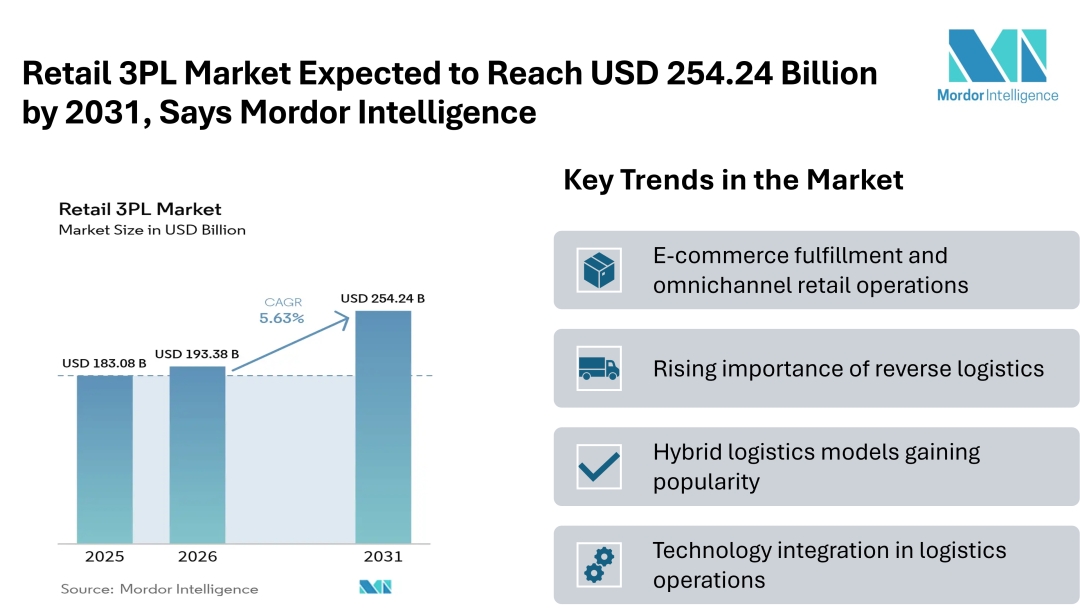
According to Mordor Intelligence, the retail 3PL market size was valued at USD 183.08 billion in 2025 and is estimated to reach USD 193.38 billion in 2026, with forecast indicating growth to USD 254.24 billion by 2031, growing at a CAGR of 5.63% during 2026-2031. The growing complexity of global retail supply chains is a major factor behind the expansion of the industry. Retailers are dealing with multi-channel sales, cross-border sourcing, and rising consumer expectations for faster deliveries. By working with logistics partners, companies can focus on merchandising and customer experience while logistics providers handle inventory management, transportation planning, and fulfillment.
In addition, modern retail supply chains rely on a combination of warehousing, transportation management, and value-added logistics services. These services are helping companies adapt to seasonal demand, expand into new markets, and manage growing volumes of parcel shipments. These developments are strengthening the overall retail 3PL market share across global retail operations.
Growth Drivers in the Retail 3PL Market
E-commerce fulfillment and omnichannel retail operations
One of the most important retail 3PL market trends is the rapid growth of online retail and omnichannel shopping. Retailers increasingly operate through both digital platforms and physical stores, which creates a need for logistics networks capable of handling multiple delivery channels.
Third-party logistics providers help manage order fulfillment for online purchases, including picking, packing, and shipping directly to customers. They also coordinate last-mile delivery through partnerships with courier networks to ensure faster and more reliable delivery times.
In omnichannel retail, inventory is often shared between warehouses and physical stores. This requires advanced inventory visibility systems so that products can be shipped from the nearest available location, reducing delivery time and cost. As online shopping expands, logistics partners are also supporting retailers with flexible capacity, seasonal scaling, and distributed warehousing strategies such as micro-fulfillment centers located closer to urban customers.
Rising importance of reverse logistics
Another important trend shaping the industry is the growing need for efficient reverse logistics. Online retail has significantly increased product returns, especially in categories such as apparel, footwear, and consumer electronics where size, fit, or preference issues are common.
Handling returns requires a structured process that includes product collection, inspection, grading, sorting, repackaging, and either restocking or disposal. Many products cannot be immediately resold as new, so logistics providers must manage refurbishment or liquidation channels as well.
Efficient reverse logistics also plays a key role in customer satisfaction, as fast and hassle-free returns improve brand trust. Many retailers rely on specialized logistics providers to offer return pickup services from customers’ homes or drop-off points. As returns volumes continue to grow, reverse logistics is becoming a major cost factor and a key differentiator for service providers in the retail 3PL market growth landscape.
Hybrid logistics models gaining popularity
Hybrid logistics networks are becoming more common in the retail 3PL market share landscape. In this model, logistics providers combine their own assets (such as warehouses, fleets, or distribution centers) with outsourced partners to increase flexibility and scalability.
This approach allows retailers to maintain reliable core logistics infrastructure while scaling up or down based on seasonal demand or market fluctuations. For example, during peak shopping periods, additional third-party carriers or temporary warehouse space may be used to handle excess volume.
Hybrid models also help improve geographic coverage. Providers can enter new regions faster by partnering with local logistics companies instead of building full infrastructure from scratch. At the same time, maintaining partial ownership of assets ensures better control over service quality, delivery timelines, and operational standards.
Technology integration in logistics operations
Digital tools are increasingly integrated into logistics operations across the retail 3PL industry, transforming how supply chains are managed. Warehouse Management Systems (WMS) help automate inventory tracking, optimize storage layouts, and improve order picking efficiency.
Transportation Management Systems (TMS) are used to plan delivery routes, reduce fuel costs, and monitor carrier performance. Real-time shipment tracking systems give both retailers and customers visibility into order status, improving transparency and reducing customer service inquiries.
Advanced technologies like AI and data analytics are also being used to forecast demand, optimize inventory placement, and reduce delivery delays. In some cases, automation technologies such as robotic picking systems and automated sorting conveyors are improving warehouse productivity and reducing human error.
Overall, technology integration enhances supply chain visibility, reduces operational costs, and allows retailers to make faster, data-driven decisions across their logistics network.
Check out more details and stay updated with the latest industry trends, including the Japanese version for localized insights: https://www.mordorintelligence.com/ja/industry-reports/global-retail-3pl-market?utm_source=abnewswire
Retail 3PL Market Segmentation
By Service
-
Domestic transportation management
-
International transportation management
-
Value-added warehousing and distribution
-
Other logistics support services
By Product Category
-
Food and beverages
-
Fashion and lifestyle products
-
Consumer electronics
-
Other retail goods
By Distribution Channel
-
Supermarkets, hypermarkets, and convenience stores
-
Department stores
-
Online retail platforms
By Logistics Model
-
Asset-based logistics networks
-
Asset-light logistics providers
-
Hybrid logistics models
By Region
-
Asia-Pacific
-
North America
-
Europe
-
South America
-
Middle East and Africa
Explore Our Full Library of Logistics Research Reports: https://www.mordorintelligence.com/market-analysis/logistics?utm_source=abnewswire
Key Players in the Retail 3PL Market
-
DHL Supply Chain
-
Kuehne + Nagel
-
DB Schenker
-
XPO Logistics
-
DSV
Explore more insights on Retail 3PL competitive landscape https://www.mordorintelligence.com/industry-reports/global-retail-3pl-market/companies?utm_source=abnewswire
Conclusion
The retail 3PL market share is becoming an essential part of the global retail supply chain as retailers rely on external logistics partners to manage increasingly complex distribution networks. Outsourced logistics services help companies maintain efficiency while responding to evolving consumer expectations and market conditions. Growth in e-commerce, international trade, and omnichannel retailing continues to support demand within the retail 3PL industry. Logistics providers are responding by expanding fulfillment networks, improving return management services, and adopting digital logistics platforms.
As retailers focus on improving delivery speed and operational flexibility, collaboration with logistics specialists will remain an important strategy. These developments are expected to sustain the market forecast, with steady retail 3PL market growth supported by efficient supply chain management, diversified logistics services, and expanding retail distribution networks worldwide.
For more insights on the Retail 3PL market, please visit the Mordor Intelligence page: https://www.mordorintelligence.com/industry-reports/global-retail-3pl-market?utm_source=abnewswire
Industry Related Reports:
GCC Warehousing and Distribution Logistics Market
The GCC warehousing and distribution logistics market is projected to grow from USD 14.45 billion in 2025 to USD 15.40 billion in 2026, reaching USD 20.94 billion by 2031 at a CAGR of 6.34%. This growth is driven by rising e-commerce demand, increasing trade activities, and significant investments in logistics infrastructure and smart warehousing technologies across the region.
Get more insights: https://www.mordorintelligence.com/industry-reports/warehousing-and-distribution-logistics-market-in-gcc?utm_source=abnewswire
Europe Contract Logistics Market Size
The Europe Contract Logistics Market is estimated at USD 94.72 billion in 2026, up from USD 91.87 billion in 2025, and is expected to reach USD 110.25 billion by 2031, growing at a CAGR of 3.10%. Market growth is supported by the region’s strong retail and manufacturing sectors, increasing automation in warehouses, and rising demand for integrated logistics solutions to optimize inventory management and distribution efficiency.
Get more insights: https://www.mordorintelligence.com/industry-reports/europe-contract-logistics-market?utm_source=abnewswire
Mexico 3PL Market Share
The Mexico 3PL Market size is estimated at USD 25.51 billion in 2026, growing from USD 24.14 billion in 2025 to reach USD 33.58 billion by 2031, at a CAGR of 5.66%. Expansion is fueled by nearshoring trends, growth in cross-border trade with the United States and increasing investment in transportation infrastructure and warehousing to support manufacturing and retail supply chains.
Get more insights: https://www.mordorintelligence.com/industry-reports/mexico-3pl-market?utm_source=abnewswire
About Mordor Intelligence:
Mordor Intelligence is a trusted partner for businesses seeking comprehensive and actionable market intelligence. Our global reach, expert team, and tailored solutions empower organizations and individuals to make informed decisions, navigate complex markets, and achieve their strategic goals.
With a team of over 550 domain experts and on-ground specialists spanning 150+ countries, Mordor Intelligence possesses a unique understanding of the global business landscape. This expertise translates into comprehensive syndicated and custom research reports covering a wide spectrum of industries, including aerospace & defense, agriculture, animal nutrition and wellness, automation, automotive, chemicals & materials, consumer goods & services, electronics, energy & power, financial services, food & beverages, healthcare, hospitality & tourism, information & communications technology, investment opportunities, and logistics.
For any inquiries or to access the full report, please contact:
media@mordorintelligence.com https://www.mordorintelligence.com/
Mordor Intelligence, 11th Floor, Rajapushpa Summit, Nanakramguda Rd, Financial District, Gachibowli, Hyderabad, Telangana – 500032, India.
Media Contact
Company Name: Mordor Intelligence
Contact Person: Jignesh Thakkar
Email: Send Email
Phone: +1 617-765-2493
Address:11th Floor, Rajapushpa Summit, Nanakramguda Rd, Financial District, Gachibowli media@mordorintelligence.com
City: Hyderabad
State: Telangana 500008
Country: India
Website: https://www.mordorintelligence.com/