
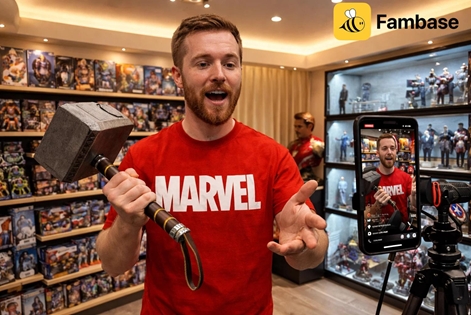
Lucas Bennett, a collectibles seller specializing in Marvel merchandise based in Seattle, has never struggled with attention.
Whenever a new film is released or a character gains momentum, his storefront and social accounts see a noticeable surge. Comments increase, messages pile up, and collectors begin asking about different versions of Iron Man helmets or Spider-Man figures. On the surface, demand appears strong and consistent.
Yet the underlying challenge has little to do with visibility.
Most of that attention does not stay. Some people ask questions and disappear. Others save items but never return. The small group of collectors who repeatedly purchase, who follow specific characters, and who are willing to wait for rare editions are far more valuable, yet they remain difficult to identify and even harder to retain.
Lucas relied on memory to manage these relationships. He remembered who preferred certain versions and who was searching for limited serial numbers. Over time, however, that system began to break down. On one occasion, he sourced a niche item simply because he vaguely recalled someone asking for it. When the product arrived, he could no longer remember who that person was. The item sold, but not to the right buyer.
These mismatches became increasingly common.
From Public Traffic to Structured Customer Retention
Lucas eventually reframed how he approached public platforms. Rather than treating them as places to complete transactions, he began to see them as entry points for attention. New audiences continued to discover his products there, and conversations still took place at scale, but he no longer expected every viewer to convert.
Instead, he started paying closer attention to behavior. Who returned multiple times. Who asked more specific questions. Who had already completed a purchase. Gradually, he began guiding these individuals into Fambase. He did not move everyone. Only those who demonstrated clear intent.
Over time, a smaller but more consistent group formed. Their preferences became clearer. Some focused on specific characters. Others waited for particular series. A few were primarily interested in high-value auction pieces.
Rather than relying on memory, Lucas began understanding these relationships through ongoing interaction. Conversations within Fambase were not fragmented or diluted, allowing him to focus more precisely on what each person cared about. At the same time, he maintained simple notes on each customer, capturing preferences and buying patterns.
This shift changed how he operated. Instead of trying to recall who might be interested, he could immediately determine where a product should appear first. What had once been scattered demand became something structured and actionable.
Turning Product Display into Real-Time Interaction and Sales
With this foundation in place, Lucas also changed how he presented products.
Previously, showcasing an item required repeated effort. He would photograph details, answer similar questions multiple times, and respond individually to each inquiry. The process was time-consuming and often disconnected from actual purchasing decisions.
On Fambase, display became immediate and shared.
When new items arrived, Lucas would go live directly within the group. Details such as condition, numbering, and design variations could be shown and clarified in real time. Everyone saw the same product simultaneously, eliminating the need for repetitive communication.
The introduction of live auctions further transformed the experience. Pricing was no longer static or negotiated privately. Instead, it emerged through participation. Bidding created momentum, and interest intensified as more people engaged. For items that were previously difficult to price, this dynamic often resulted in stronger outcomes. What had been a passive listing became an active, competitive environment.
Concentrating Demand to Improve Conversion and Revenue Stability
The most significant shift occurred in how transactions happened.
Previously, Lucas depended on visibility. A product would be posted, discovered, and then slowly move toward a potential sale. Now, he could present items directly to those most likely to purchase them.
Information no longer competed with irrelevant content. The path from discovery to transaction became shorter and more controlled. Sales took place within the same environment, without requiring users to switch platforms or repeat steps.
This shift led to more consistent outcomes. The same product, when introduced to a general audience versus a concentrated group of interested buyers, produced noticeably different results. Over time, these differences became predictable.
From Audience Growth to Relationship-Based Revenue
For merchants like Lucas, the transformation is not about what they sell, but how their business is structured.
When operations move away from serving everyone equally and instead focus on a clearly identified group of high-value customers, growth becomes more stable and more intentional. Public platforms continue to generate awareness and attract new interest, but revenue increasingly depends on those who are retained, understood, and consistently engaged.
Fambase has already enabled merchants and community operators across more than 50 countries to build businesses around this model. From collectibles to niche interest groups, sellers are using structured communities to convert dispersed attention into durable relationships and, in turn, more predictable income streams.
Fambase is currently open to merchants and partners. Sellers benefit from retaining up to 92 percent of their transaction revenue, while partners can participate in the platform’s growth by bringing in high-quality merchants and sharing in long-term value creation.
For inquiries and partnerships, please contact: EveSmith@joinfambase.com
Media Contact
Company Name: SocialSignal Lab
Contact Person: Julian Rowe
Email: Send Email
City: Seattle
State: Washington
Country: United States
Website: https://medium.com/@julianblogsite