
In the fresh produce supply chain, spoilage has long been a persistent and costly challenge. A freshly picked strawberry, from farm to consumer, must survive harvesting, sorting, packaging, transportation, warehousing, and retail display. At every stage, jostling, compression, moisture, and mold can prematurely end its journey—adding to the bottom-line losses that plague the industry.
Industry data shows that in China, fruit and vegetable spoilage during distribution can reach 20-30%, while in many developed markets, that figure stands at around 5%. For fresh produce supply chain operators, finding ways to reduce this gap has become an urgent priority.
Meidi Medical, a company with 25 years of expertise in medical-grade cleaning and care paper, has turned its attention to this very challenge—with a single product: the fruit and vegetable liner.
A Technology Transfer from the Operating Room to the Produce Box
Meidi’s core technology was originally developed to serve the most demanding environments: hospital operating rooms, ICUs, and sterile processing centers. Its proprietary 5C Clean Patent Technology and GMP 100,000-level clean workshops ensure that every sheet meets a microbial standard of
When Meidi applied this technology to fruit and vegetable liners, the question was: how can a single sheet of paper solve the twin problems of moisture and pressure during transport and storage?
More Than Just Absorbent: Engineered to Lock Moisture Away
Traditional packaging often uses ordinary paper or plastic film as a liner. Standard paper absorbs moisture but quickly becomes saturated, allowing that moisture to seep back and keep produce in a damp environment that accelerates rot. Plastic film, while waterproof, traps condensation against the produce, creating ideal conditions for mold and decay.
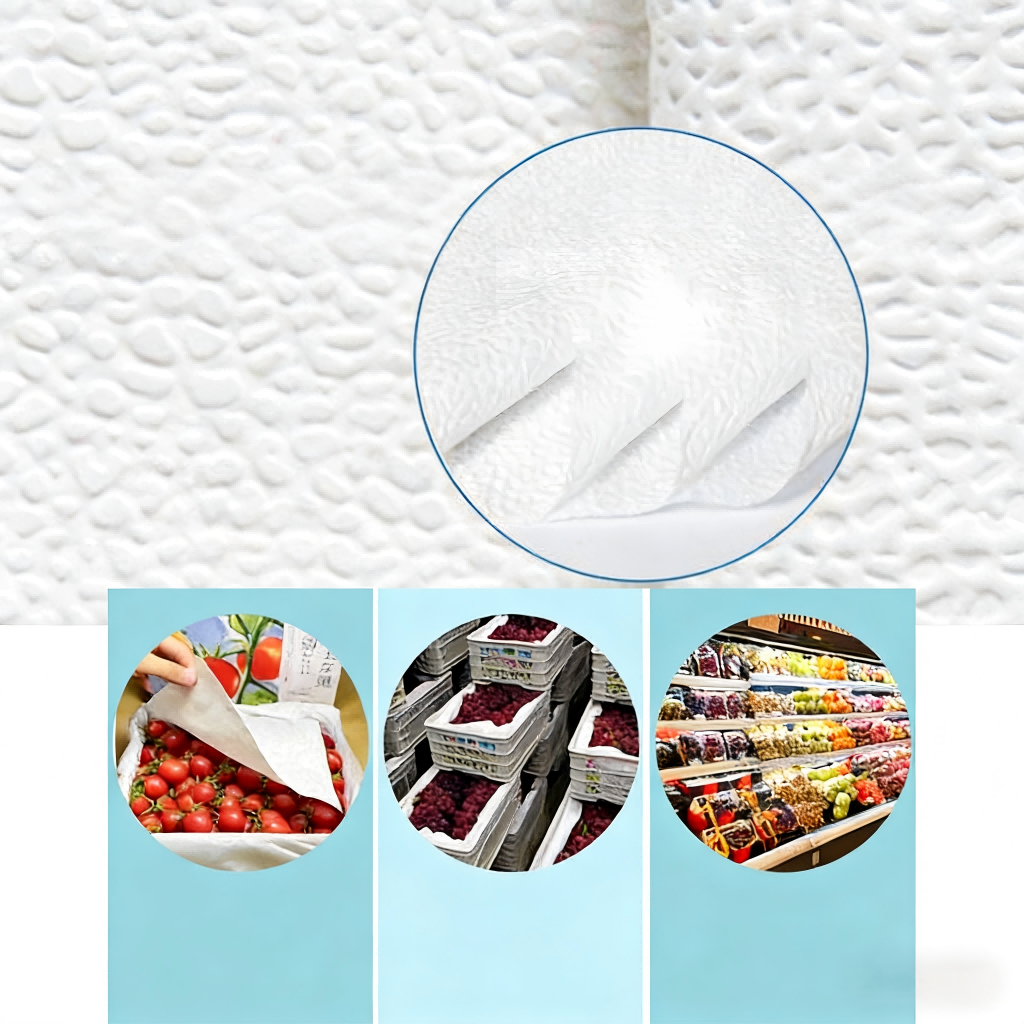
Meidi’s liner breaks this cycle with a four-layer composite structure:
Absorption layer: Rapidly wicks away moisture from produce respiration, juice leakage, and condensation.
Lock-in layer: Traps moisture inside the paper, preventing backflow to the fruit or vegetable surface.
Barrier layer: Prevents liquid from reaching the bottom of the carton.
Textured surface layer: The embossed pattern creates air pockets that promote airflow and keep the produce surface dry.
The result: each sheet absorbs up to 20-30 times its own weight in liquid, and it stays locked away—no reabsorption, no prolonged wet contact.
Real Results: How Spoilage Dropped by 5-10%
In a trial conducted with a major e-commerce fresh produce distributor, cherries packed with Meidi liners showed a spoilage rate reduction from 8.2% to 3.1% after 72 hours of cold-chain transport—a decline of over 5 percentage points. Across trials with grapes, blueberries, and strawberries, spoilage reduction consistently ranged between 5% and 10%.
These improvements come from three key mechanisms:
1.Reducing juice saturation: When fruits are jostled during transit, minor cracks release juice that can accelerate rot in surrounding produce. Meidi’s rapid absorption stops this chain reaction before it starts.
2.Preventing condensation damage: Temperature fluctuations in cold-chain logistics create moisture inside packaging. Ordinary liners become waterlogged and ineffective; Meidi’s lock-in layer ensures surfaces stay dry.
3.Providing cushioning: The textured, thicker construction adds a soft layer of protection against impact and compression during stacking and transport.
Not Just for Fruit—Essential for Vegetables Too
Beyond fruits, Meidi liners have proven their value in vegetable supply chains. For leafy greens, the liners absorb moisture from respiration, delaying yellowing and wilting. For root vegetables, they help regulate humidity inside storage containers, suppressing sprouting and extending usable life.
One large-scale vegetable grower using Meidi liners for broccoli reported an extension of cold-storage shelf life from 7 days to 12 days, significantly expanding their distribution reach.
Value Across the Entire Supply Chain
Different players in the fresh produce ecosystem benefit from Meidi liners in different ways:
|
Customer Type |
Key Benefit |
|
Farms & Growers |
Reduced harvest-to-shipping losses, higher marketable yield |
|
Packaging Suppliers |
Enhanced product offering, differentiation for high-value clients |
|
Distributors & Wholesalers |
Extended shelf life, larger distribution radius, reduced claims |
|
E-commerce & Retail |
Better unboxing experience, fewer returns and complaints, lower customer service costs |
|
End Consumers |
Fresher produce, improved satisfaction and repeat purchase |
Medical Standards, Everyday Solutions
The story of Meidi’s fruit and vegetable liners is a compelling example of how advanced medical technology can solve practical problems far beyond the hospital. When the same principles of cleanliness, absorption, and material science developed for surgical environments are applied to fresh produce packaging, the result is measurable commercial value.
From the operating room to the fruit basket, Meidi is connecting medical-grade technology with the daily needs of the food supply chain—helping businesses turn the industry’s persistent 20% spoilage challenge into a 5-10% opportunity for higher margins and better products.
Meidi Fruit & Vegetable Liners – Key Specifications
|
Feature |
Advantage |
|
Absorption Capacity |
Up to 20-30x its own weight, with anti-backflow design |
|
Lint & Dust Control |
≤0.5% dust shedding, no fiber residue |
|
Wet Strength |
Ball burst strength ≥1.5N; remains intact when wet |
|
Hygiene Standard |
|
|
Customization |
Size, embossing pattern, and packaging can be tailored |
For fresh produce supply chain partners looking to reduce spoilage and improve product quality, sample testing is available.
Media Contact
Company Name: Shandong Meidi Medical Supplies Co., Ltd.
Email: Send Email
Country: China
Website: https://www.medtissue.com/