
Global Mobile Robots Market Overview
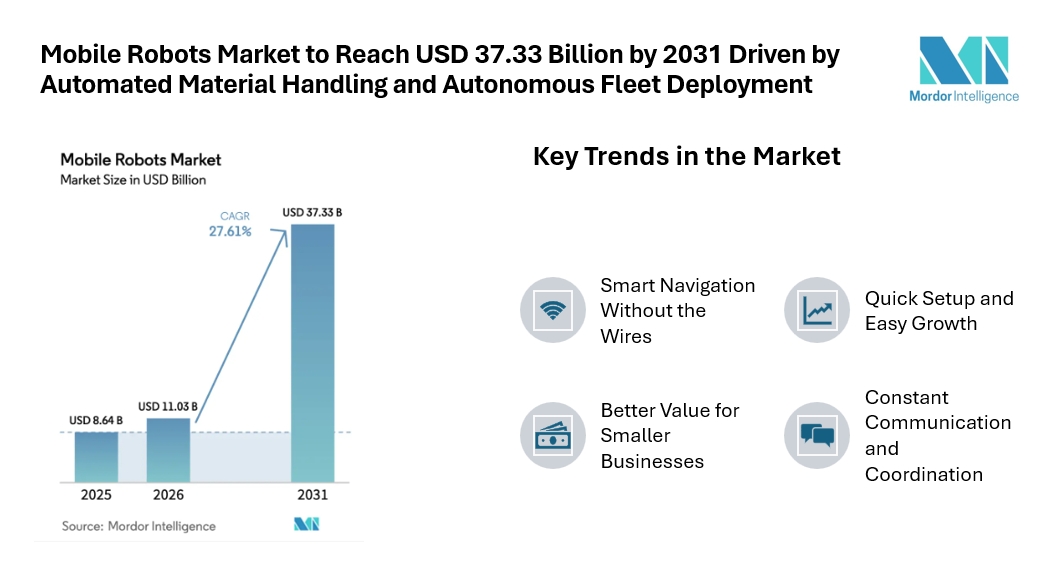
According to Mordor Intelligence, in 2025, the mobile robots market size is projected to be USD 8.64 billion. As organizations seek, the sector is expected to reach USD 11.03 billion in 2026. Looking further ahead, the mobile robots market forecast suggests the industry will reach USD 37.33 billion by 2031. This expansion represents a steady mobile robots market growth with a CAGR of 27.61% from 2026 to 2031. This upward trajectory is fueled by a change in perspective where material handling is no longer just a cost to be managed, but a strategic tool to improve how quickly orders are filled and how effectively labor is used.
Modern fulfillment centers are moving away from fixed infrastructure like traditional conveyor belts. Instead, they are deploying fleets ranging from 50 to 200 autonomous units. This change helps reduce the time it takes from receiving an order to shipping it out, often cutting the cycle from several hours down to just a few minutes. Because these mobile solutions can be set up in a matter of weeks without major construction work, they offer a way to increase capacity quickly. The financial aspect also supports this shift, as businesses can avoid the long periods of downtime and high costs associated with permanent installations.
Mobile Robots Market Growth Drivers
Smart Navigation Without the Wires
Warehouses are moving away from old-fashioned robots that can only follow fixed lines or magnetic strips on the floor. Instead, new systems use smart sensors to “see” their environment, allowing them to dodge obstacles and find their own paths without any human help. This shift means the robots are no longer stuck on a single track and can navigate complex rooms just like a person would.
Quick Setup and Easy Growth
One of the biggest changes is how fast these systems can be put to work. Because they don’t need special tracks or wires built into the floor, businesses can get a fleet running in just a few weeks instead of waiting months for construction. This makes it simple for a company to add more robots during busy holiday seasons and then scale back when things get quiet, all without changing the physical building.
Better Value for Smaller Businesses
As the cost of the parts and technology inside these machines decreases, even smaller companies can now afford to use them. In the past, only the largest corporations could justify the expense, but today the return on investment happens much faster. This change is making automated moving tools a standard part of everyday logistics for businesses of all sizes.
Constant Communication and Coordination
These robots stay connected through fast wireless networks, talking to each other and the main office in real-time. This constant communication helps them coordinate their movements perfectly, making sure they don’t get stuck in “traffic jams” on the factory floor. By sharing their location and status, they keep the workflow moving fast and avoid any safety issues or delays.
Check out more details and stay updated with the latest industry trends, including the Japanese version for localized insights: https://www.mordorintelligence.com/ja/industry-reports/global-mobile-robots-market?utm_source=abnewswire
Mobile Robots Market Segmentation
-
By Product Type
-
Automated Guided Vehicles
-
Autonomous Mobile Robots
-
Autonomous Mobile Manipulation Robots
-
Unmanned Ground Vehicles
-
Unmanned Aerial Vehicles
-
By Form Factor
-
Self-Driving Forklifts
-
Tow, Tractor, and Tug Robots
-
Unit-Load and Cart Robots
-
Assembly-Line Mobile Platforms
-
By Navigation Technology
-
LiDAR-Based SLAM
-
QR and Fiducial Codes
-
Camera-Only Vision
-
Hybrid Systems
-
Magnetic and Reflector Guidance
-
By End-Use Industry
-
Warehousing and Distribution
-
Manufacturing
-
Food and Beverage
-
Pharmaceuticals and Healthcare
-
Other End-Use Industries
-
By Payload Capacity
-
Below 100 kg
-
100 – 500 kg
-
500 – 1,000 kg
-
Above 1,000 kg
-
By Geography
-
North America (United States, Canada, Mexico)
-
Europe (United Kingdom, Germany, France, Italy, Rest of Europe)
-
Asia Pacific (China, Japan, India, South Korea, Rest of Asia Pacific)
-
South America (Brazil, Argentina, Rest of South America)
-
Middle East and Africa (UAE, Saudi Arabia, South Africa, Egypt)
Mobile Robots Industry Leaders
-
Teradyne, Inc.
-
KION Group AG:
-
Toyota Industries Corporation:
-
Daifuku Co., Ltd.
-
Boston Dynamics, Inc.
Conclusion
The movement toward automated transport is no longer a luxury for large corporations but a necessity for any business dealing with high-volume logistics. As the mobile robots market continues to mature, the focus is shifting from simple point-to-point transport to intelligent fleet management. The ability to deploy these systems quickly and the avoidance of expensive civil works make them a preferred choice for modern supply chains. With significant growth expected over the next decade, the industry is set to become a foundation of global manufacturing and distribution.
The transition to autonomous units is helping companies overcome labor shortages and increase the speed of their operations. While the market faces challenges such as price competition and the need for standardized communication between different robot brands, the benefits of scalability and efficiency remain clear. As technology becomes more accessible and navigation systems become more reliable, the presence of mobile robots on the factory floor and in the warehouse will become a standard sight across the globe. By 2031, the landscape of material handling will look vastly different, defined by flexible, intelligent, and autonomous fleets that keep the world’s goods moving.
Industry Related Reports:
The radar sensors market is projected to reach USD 61.16 billion by 2031, fueled by a robust CAGR of 16.44% starting from 2026. This significant expansion is primarily driven by the increasing integration of advanced driver assistance systems (ADAS) in automotive manufacturing and the rising demand for sophisticated surveillance and security infrastructure.
Valued at USD 4.56 billion in 2025, the solenoid valves market is forecast to grow to USD 6.16 billion by 2031 at a steady CAGR of 5.13%. Growth in this sector is largely supported by the automation of industrial processes and the expanding need for efficient fluid control systems in the water treatment and chemical processing industries.
The sensor fusion market is estimated to grow from USD 10.04 billion in 2026 to USD 18.21 billion by 2031, maintaining a CAGR of 12.65%. The market’s upward trajectory is underpinned by the proliferation of IoT devices and the necessity for high-accuracy data processing in autonomous vehicles and consumer electronics.
About Mordor Intelligence:
Mordor Intelligence is a trusted partner for businesses seeking comprehensive and actionable market intelligence. Our global reach, expert team, and tailored solutions empower organizations and individuals to make informed decisions, navigate complex markets, and achieve their strategic goals.
With a team of over 550 domain experts and on-ground specialists spanning 150+ countries, Mordor Intelligence possesses a unique understanding of the global business landscape. This expertise translates into comprehensive syndicated and custom research reports covering a wide spectrum of industries, including aerospace & defense, agriculture, animal nutrition and wellness, automation, automotive, chemicals & materials, consumer goods & services, electronics, energy & power, financial services, food & beverages, healthcare, hospitality & tourism, information & communications technology, investment opportunities, and logistics.
For any inquiries or to access the full report, please contact:
media@mordorintelligence.com
https://www.mordorintelligence.com/
Mordor Intelligence, 11th Floor, Rajapushpa Summit, Nanakramguda Rd, Financial District, Gachibowli, Hyderabad, Telangana – 500032, India
Media Contact
Company Name: Mordor Intelligence
Contact Person: Jignesh Thakkar
Email: Send Email
Phone: +1 617-765-2493
Address:11th Floor, Rajapushpa Summit, Nanakramguda Rd, Financial District, Gachibowli media@mordorintelligence.com
City: Hyderabad
State: Telangana 500008
Country: India
Website: https://www.mordorintelligence.com/