
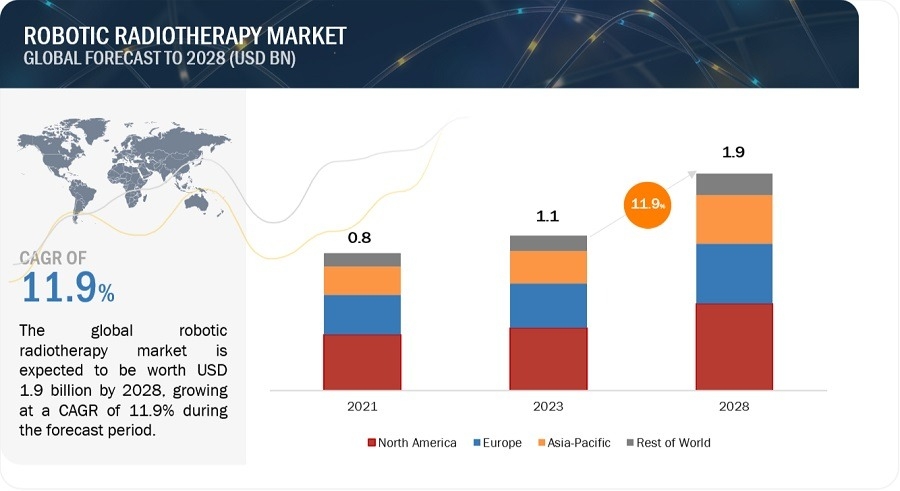
The global robotic radiotherapy market is witnessing significant expansion as healthcare providers increasingly adopt advanced radiation technologies for cancer treatment. Valued at approximately USD 0.8 billion in 2021, the market grew to about USD 1.1 billion in 2023 and is projected to reach nearly USD 1.9 billion by 2028, expanding at a robust CAGR of 11.9% during the forecast period. The growing global burden of cancer, combined with increasing demand for precise and minimally invasive treatment solutions, is driving the adoption of robotic radiotherapy systems worldwide.
Download PDF Brochure: https://www.marketsandmarkets.com/pdfdownloadNew.asp?id=122256158
The market’s growth is primarily fueled by advancements in automation technologies that enhance treatment precision and clinical outcomes. Robotic radiotherapy systems enable highly targeted radiation delivery, reducing damage to surrounding healthy tissues and minimizing side effects for patients. In addition, the expansion of cancer treatment facilities and increasing collaborations between radiotherapy system manufacturers and software developers are further supporting market development. For instance, collaborations between major healthcare technology companies and radiotherapy software providers are enabling more efficient treatment planning and simulation workflows.
Furthermore, increasing healthcare expenditure and government initiatives aimed at improving cancer treatment infrastructure are expected to create new growth opportunities for the robotic radiotherapy market. Many developing countries are investing in modern cancer treatment facilities while promoting medical tourism to strengthen healthcare systems. However, the high cost of radiotherapy systems and a shortage of trained professionals remain key challenges that could restrain the widespread adoption of these advanced technologies.
Technological Advancements in Radiation Therapy Driving Market Growth
Technological innovations in radiation therapy have played a crucial role in transforming cancer treatment, leading to the development of sophisticated robotic radiotherapy systems that significantly improve treatment accuracy and efficiency. These systems integrate advanced automation, imaging technologies, and artificial intelligence to enhance clinical decision-making and treatment planning.
One of the most important developments in radiation therapy is the use of computerized treatment planning systems. These systems employ advanced algorithms and modeling techniques to design personalized treatment plans tailored to the patient’s anatomy and tumor characteristics. By analyzing tumor location and radiation dosage requirements, these systems optimize treatment delivery while minimizing exposure to surrounding healthy tissues. This not only improves treatment effectiveness but also reduces complications and side effects.
Recent innovations highlight the pace of technological advancement in the sector. In 2023, MIM Software received regulatory approval for its AI-based auto-contouring solution, Contour ProtégéAI. The software enhances radiation oncology workflows by offering improved algorithms that support molecular radiotherapy planning and deliver more accurate treatment outcomes. Similarly, Brainlab AG introduced the ExacTrac Dynamic Surface system in 2023, designed for surface-guided radiation therapy (SGRT). The technology improves patient positioning and monitoring, ensuring highly precise radiation delivery during treatment.
Such innovations demonstrate how advanced automation and artificial intelligence are revolutionizing cancer treatment. As robotic radiotherapy technologies continue to evolve, healthcare providers are expected to benefit from improved treatment precision, shorter treatment times, and better patient outcomes. These technological advancements are expected to remain a key driver of market growth in the coming years.
Shortage of Skilled Radiologists and Oncologists Restraining Market Expansion
Despite the promising growth prospects of robotic radiotherapy systems, the shortage of skilled radiologists and oncologists capable of operating advanced radiation technologies remains a major challenge for the market. Robotic radiotherapy systems require highly specialized expertise, as physicians must understand both radiation therapy techniques and the sophisticated automated systems used to plan and deliver treatment.
These systems rely on complex algorithms, machine learning tools, and automated treatment planning technologies that demand specialized training. However, many radiology training programs still focus primarily on conventional radiation therapy methods, leaving limited exposure to advanced automated systems. As a result, many healthcare facilities face difficulties in finding professionals with the required technical expertise.
The shortage of radiologists is a well-recognized issue across several regions. For example, Europe has approximately 13 radiologists per 100,000 population, while the United Kingdom has around 8.5 radiologists per 100,000 people. Similar workforce shortages are observed in emerging economies. In India, there is a significant gap between the number of cancer patients and the availability of oncology specialists. According to estimates from the Indian Council for Medical Research (ICMR), cancer cases in India are expected to increase from about 26.7 million in 2021 to nearly 29.8 million by 2025. However, the country currently has only around 200 oncologists per million cancer patients.
This shortage of skilled professionals can limit the utilization of advanced radiotherapy systems even when healthcare institutions invest in them. Hospitals may struggle to fully implement these technologies without trained specialists capable of managing complex radiotherapy workflows. Expanding training programs and improving access to advanced radiotherapy education will therefore be critical for unlocking the full potential of robotic radiotherapy systems.
Get Sample Pages: https://www.marketsandmarkets.com/requestsampleNew.asp?id=122256158
Growing Investments in Cancer Treatment Creating Market Opportunities
Increasing public and private investments in cancer diagnosis and treatment infrastructure are expected to create significant growth opportunities for the robotic radiotherapy market. Radiotherapy has long been recognized as a standard and essential treatment modality for many types of cancer, and the rising global cancer burden is driving demand for advanced radiation therapy solutions.
However, there remains a significant gap in radiotherapy infrastructure across different regions. For instance, the United States has approximately 12 linear accelerators per million people, while European countries have around five to eight machines per million population. In contrast, many developing regions across Asia, Africa, and Latin America have fewer than one radiotherapy machine per million people. Bridging this gap requires large-scale investments in treatment infrastructure, with estimates suggesting that more than 10,000 additional radiotherapy machines are needed globally.
Governments and private investors are increasingly funding initiatives aimed at expanding access to cancer treatment technologies. In 2021, Leo Cancer Care secured USD 25.3 million in funding from global investors to support the development of innovative upright radiotherapy systems designed to improve patient comfort and treatment efficiency. Similarly, the Australian government launched a USD 45.5 million funding program in 2020 to develop regional radiation treatment centers across several states, improving access to cancer care for rural populations.
Such investments are expected to accelerate the adoption of advanced radiotherapy technologies, including robotic radiotherapy systems, particularly in emerging markets where cancer treatment infrastructure is still developing. As healthcare systems continue to prioritize cancer care, the demand for innovative and precise radiation therapy solutions is expected to grow steadily.
From a segmentation perspective, the software segment accounted for a significant share of the market due to the rapid integration of artificial intelligence and advanced planning tools in radiation therapy. Based on technology, linear accelerators dominate the market due to their widespread adoption and continuous technological advancements. In terms of application, lung cancer represents a major segment owing to the increasing global prevalence of the disease and rising use of radiotherapy in treatment protocols. Hospitals remain the largest end-user segment due to growing patient volumes and increasing investments in oncology infrastructure.
Regionally, North America is expected to maintain the largest share of the robotic radiotherapy market due to its advanced healthcare infrastructure, strong presence of leading technology providers, and high adoption of innovative cancer treatment solutions. Key companies operating in the market include Siemens Healthcare GmbH, Elekta, Accuray Incorporated, IBA, ViewRay Technologies, C-RAD, Hitachi Ltd., Mevion Medical Systems, Optivus Proton Therapy, Panacea Medical Technologies Pvt. Ltd., and P-Cure, among others.
Related Reports-
Media Contact
Company Name: MarketsandMarkets™ Research Private Ltd.
Contact Person: Mr. Rohan Salgarkar
Email: Send Email
Phone: 18886006441
Address:1615 South Congress Ave. Suite 103, Delray Beach, FL 33445
City: Florida
State: Florida
Country: United States
Website: https://www.marketsandmarkets.com/Market-Reports/robotic-radiotherapy-market-122256158.html