
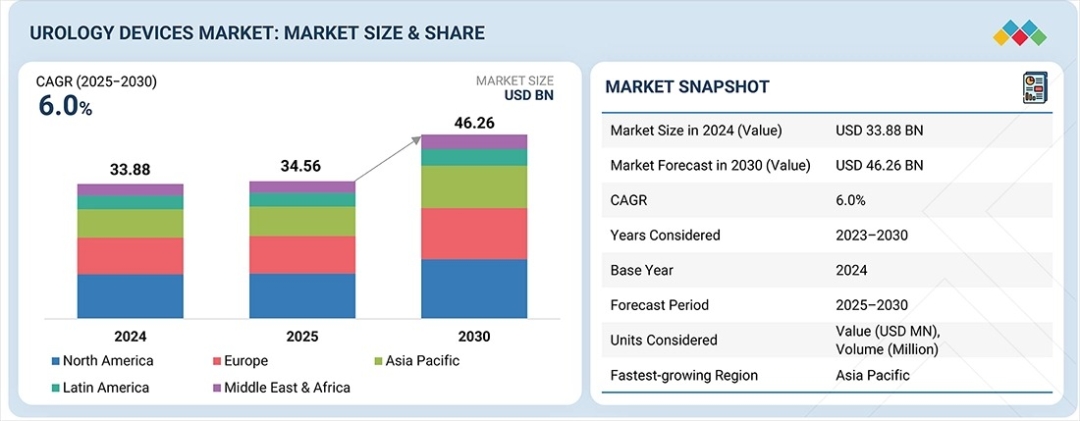
The global urology devices market is projected to grow significantly over the coming years, reflecting the increasing burden of urological disorders and the continuous advancement of diagnostic and surgical technologies. The market is estimated to be valued at USD 35.56 billion in 2025 and is expected to reach USD 46.26 billion by 2030, expanding at a CAGR of 6.0% during the forecast period.
Download PDF Brochure: https://www.marketsandmarkets.com/pdfdownloadNew.asp?id=173062212
The rising prevalence of urological diseases, chronic metabolic conditions, and lifestyle-related disorders is one of the primary factors fueling market growth. Conditions such as benign prostatic hyperplasia (BPH), kidney diseases, urinary incontinence, and urological cancers are becoming more common worldwide, thereby increasing the demand for advanced diagnostic and treatment devices. Furthermore, the adoption of minimally invasive procedures, including advanced endoscopic techniques, is significantly improving diagnostic precision and procedural outcomes. Healthcare providers and patients are increasingly recognizing the benefits of modern urology devices that offer improved treatment efficiency, reduced recovery times, and enhanced clinical outcomes. The growing awareness of advanced treatment options and expanding healthcare infrastructure in emerging markets are also contributing to the broader adoption of innovative urology technologies. Collectively, these trends are strengthening the growth trajectory of the global urology devices market and improving patient care across diverse healthcare settings.
Rising Incidence of Urological Diseases Driving Market Expansion
The growing global prevalence of urological diseases is a major driver accelerating the demand for advanced urology devices. Chronic conditions such as diabetes, obesity, and cancer are closely associated with a higher risk of urological complications, including kidney disorders, urinary tract infections, and prostate diseases. As these lifestyle-related and chronic diseases continue to increase worldwide, the need for effective diagnostic, monitoring, and treatment solutions is expanding rapidly. Regular diagnostic testing and early disease detection have become essential components of modern healthcare systems, driving the adoption of reliable and technologically advanced urology devices across hospitals and specialized clinics.
Preventive healthcare initiatives and screening programs are further contributing to the growth of the market. Governments and healthcare organizations are increasingly promoting early diagnosis to reduce long-term treatment costs and improve patient outcomes. As a result, healthcare providers are investing in advanced diagnostic systems and minimally invasive surgical tools that allow for faster and more accurate detection of urological conditions. Technologies such as cystoscopy, lithotripsy, and nephroscopy are widely used for diagnosing and managing complex urological disorders. The growing adoption of minimally invasive procedures also improves patient comfort, reduces hospital stays, and lowers the risk of complications. These factors collectively contribute to the expanding clinical application of urology devices and strengthen their role in modern healthcare systems worldwide.
Emerging Economies Creating Strong Growth Opportunities
Emerging economies are expected to play a pivotal role in the expansion of the global urology devices market in the coming years. Rapid improvements in healthcare infrastructure, increasing healthcare expenditure, and supportive government policies are encouraging the adoption of advanced medical technologies across developing regions. Countries in the Asia Pacific, Latin America, and parts of the Middle East are witnessing significant investments in healthcare systems, which is improving access to specialized medical treatments, including urological care. The growing middle-class population and rising disposable incomes are also increasing the demand for advanced medical procedures and improved healthcare services.
In addition, governments in many emerging economies are implementing policies that encourage innovation and local manufacturing within the medical device industry. Favorable regulatory environments and investment incentives are attracting global manufacturers to expand their presence in these regions. The rapid growth of private healthcare providers and specialty hospitals is further accelerating the demand for advanced urology devices. As awareness of urological health increases and diagnostic capabilities expand, patients are seeking more effective treatment options that offer improved clinical outcomes and faster recovery times. Manufacturers are responding by developing cost-effective and technologically advanced products designed specifically for the needs of emerging markets. These factors collectively present significant opportunities for sustained market growth and innovation in the global urology devices industry.
Market Segmentation Highlights Key Product and Application Trends
The urology devices market is segmented by product, application, and end user, each contributing to the overall expansion of the industry. By product, the market is divided into instruments and consumables & accessories, with the instruments segment accounting for the largest share. Instruments such as endoscopes, cystoscopes, resectoscopes, and lithotripters are essential for a wide range of diagnostic and surgical procedures. Their high technological complexity, precision capabilities, and extensive use in minimally invasive procedures make them a major contributor to overall market revenue. Although consumables such as catheters, drainage bags, and guidewires are widely used in daily clinical operations, the instruments segment continues to dominate due to its higher value and importance in specialized procedures.
Based on application, the market includes kidney diseases, urological cancers, pelvic organ prolapse, benign prostatic hyperplasia, urinary incontinence, erectile dysfunction, urinary stones, and other urological disorders. Among these, kidney disease applications account for the largest share, driven by the rising global prevalence of chronic kidney disease and the increasing need for advanced diagnostic and therapeutic solutions. Urology devices are extensively used in procedures such as dialysis, nephroscopy, and minimally invasive surgical interventions to manage kidney-related disorders effectively.
In terms of end users, hospitals represent the largest segment due to the high volume of urological procedures performed in these settings and the availability of advanced diagnostic infrastructure. Hospitals house specialized urology departments and perform complex surgeries for kidney disorders, prostate conditions, and urinary tract diseases, generating significant demand for both instruments and consumables. Ambulatory surgical centers and clinics are also gaining prominence due to the growing preference for minimally invasive outpatient procedures. Meanwhile, dialysis centers continue to expand as the prevalence of chronic kidney disease rises globally. Home care settings are also emerging as a growing segment, supported by the increasing use of portable and patient-friendly urology devices designed for long-term patient management.
Request Sample Pages: https://www.marketsandmarkets.com/requestsampleNew.asp?id=173062212
North America Leads the Global Urology Devices Market
North America currently holds the largest share of the global urology devices market, supported by its well-established healthcare infrastructure and high healthcare expenditure. The region benefits from advanced diagnostic technologies, widespread adoption of minimally invasive procedures, and the strong presence of leading medical device manufacturers. The increasing prevalence of urological disorders, including kidney diseases, prostate conditions, and urinary incontinence, is further driving the demand for innovative diagnostic and therapeutic solutions.
Technological advancements, particularly in robotic-assisted surgery and minimally invasive treatment techniques, are also contributing to the region’s market leadership. Favorable reimbursement frameworks and strong regulatory support encourage healthcare providers to adopt advanced urology devices. Additionally, the growing trend of home-based healthcare and remote patient monitoring is increasing the demand for portable and easy-to-use urology devices designed for long-term care.
Key companies operating in the global urology devices market include Fresenius Medical Care AG & Co. KGaA, Boston Scientific Corporation, Becton, Dickinson and Company, B. Braun Melsungen AG, Cardinal Health, Olympus Corporation, Intuitive Surgical, Coloplast A/S, Stryker Corporation, Teleflex Incorporated, Convatec Group PLC, and Medtronic PLC. These organizations are actively focusing on product innovation, strategic collaborations, and expansion into emerging markets to strengthen their competitive position and meet the growing global demand for advanced urology solutions.
Related Reports:
Chemiluminescence Immunoassay Market
Media Contact
Company Name: MarketsandMarkets™ Research Private Ltd.
Contact Person: Mr. Rohan Salgarkar
Email: Send Email
Phone: 18886006441
Address:1615 South Congress Ave. Suite 103, Delray Beach, FL 33445
City: Florida
State: Florida
Country: United States
Website: https://www.marketsandmarkets.com/Market-Reports/urology-devices-market-173062212.html