
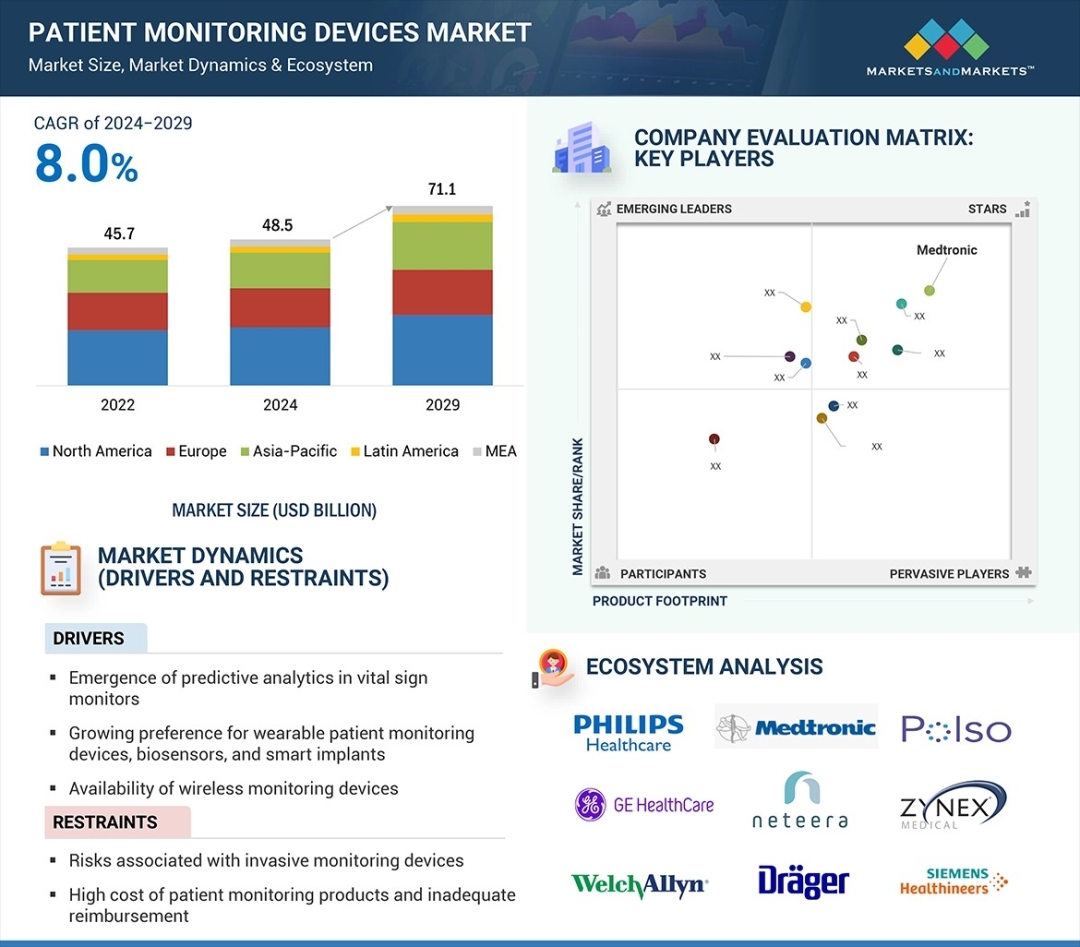
The global patient monitoring devices market, valued at US$45.7 billion in 2022, reached US$48.5 billion in 2024 and is projected to grow at a CAGR of 8.0% from 2024 to 2029, reaching an estimated US$71.1 billion by the end of the forecast period. The market is expanding rapidly due to the increasing prevalence of chronic diseases, a growing aging population, and continuous advancements in healthcare technologies. In addition, the rising demand for remote monitoring solutions and wireless medical devices is transforming how patient data is collected and analyzed in healthcare settings. Patient monitoring devices play a critical role in tracking vital parameters such as blood glucose levels, cardiac activity, respiratory rate, and body temperature, enabling healthcare providers to deliver more accurate and timely treatment. However, the high cost of advanced monitoring systems and stringent regulatory requirements remain significant barriers for market expansion. Despite these challenges, technological innovations such as artificial intelligence (AI)-driven analytics and personalized patient monitoring solutions are expected to create substantial opportunities for market players worldwide.
Download PDF Brochure: https://www.marketsandmarkets.com/pdfdownloadNew.asp?id=678
Increasing Adoption of Wireless Monitoring Devices Driving Market Expansion
The healthcare industry is undergoing a significant transformation with the increasing adoption of wireless patient monitoring devices. Traditional monitoring systems often required patients to remain connected to bedside equipment, limiting mobility and comfort. Wireless monitoring technologies are addressing this limitation by enabling continuous patient monitoring without restricting movement, thereby improving patient experience and care delivery.
Wireless monitoring devices allow healthcare providers to collect real-time data on vital parameters such as heart rate, blood pressure, oxygen levels, and blood gluco se levels. Continuous monitoring enables clinicians to detect early warning signs of deterioration and respond promptly, improving patient outcomes and reducing the risk of complications. Compared to traditional intermittent monitoring, wireless devices provide a comprehensive and uninterrupted stream of patient data, allowing healthcare professionals to gain deeper insights into a patient’s health status.
The increasing use of wearable devices and remote monitoring systems is further accelerating the adoption of wireless patient monitoring technologies. These devices allow patients to track their health metrics outside hospital settings, supporting the shift toward home-based care and telemedicine services. Wireless monitoring is particularly beneficial for patients suffering from chronic conditions such as diabetes, cardiovascular diseases, and respiratory disorders that require continuous health tracking.
Furthermore, healthcare providers are increasingly investing in digital healthcare infrastructure to support wireless monitoring systems. Hospitals and clinics are integrating advanced monitoring solutions with electronic health records (EHRs) and cloud-based platforms to streamline patient data management. These developments are enhancing the efficiency of healthcare delivery while reducing the burden on healthcare professionals, making wireless monitoring devices a key driver of the patient monitoring devices market.
Artificial Intelligence Integration and Growing Demand for Advanced Monitoring Solutions
Artificial intelligence (AI) integration in patient monitoring systems is emerging as one of the most promising opportunities for market growth. Modern patient monitoring devices generate vast volumes of health data, including vital signs, waveform analysis, and physiological trends. AI-powered analytics tools enable healthcare providers to analyze these large datasets quickly and efficiently, transforming raw data into actionable clinical insights.
AI algorithms can identify patterns, detect anomalies, and predict potential health risks in real time. This capability enables predictive risk stratification, allowing clinicians to identify patients who may require immediate intervention. As a result, AI-enabled monitoring systems can support early diagnosis, improve treatment accuracy, and reduce hospital readmission rates. The use of AI also facilitates the development of personalized treatment plans tailored to individual patient conditions and health histories.
Another key area of growth is the increasing demand for advanced monitoring solutions in surgical and outpatient settings. Ambulatory Surgical Centers (ASCs) are expected to be the fastest-growing end-user segment in the patient monitoring devices market during the forecast period. These facilities require portable, user-friendly monitoring systems that can efficiently track patient vitals during minimally invasive procedures while maintaining workflow efficiency. The ability to deploy compact and cost-effective monitoring solutions makes these devices particularly suitable for ASCs.
Among product categories, Blood Glucose Monitoring Systems (BGMS) are expected to hold the largest share of the patient monitoring devices market during the forecast period. The rapid increase in diabetes prevalence worldwide has driven strong demand for glucose monitoring technologies. Continuous glucose monitoring (CGM) systems, in particular, have revolutionized diabetes management by providing real-time glucose readings without the need for frequent finger-stick testing. Wearable glucose monitoring devices are also gaining popularity due to their convenience and improved patient compliance.
The increasing number of companies entering the BGMS segment is accelerating technological innovation and contributing to the development of more accurate and affordable monitoring devices. These advancements are expected to further strengthen the growth of the patient monitoring devices market in the coming years.
Request Sample Pages: https://www.marketsandmarkets.com/requestsampleNew.asp?id=678
Regional Trends, Market Challenges, and Competitive Landscape
From a regional perspective, North America held the largest share of the global patient monitoring devices market, accounting for approximately 34.0% of the total market in 2023. The region’s dominance can be attributed to its well-developed healthcare infrastructure, high healthcare expenditure, and rapid adoption of advanced medical technologies. The presence of leading medical device manufacturers and strong investment in healthcare innovation also contributes significantly to the growth of the market in North America.
Meanwhile, the Asia Pacific region is expected to register the highest CAGR during the forecast period. The region’s growth is driven by factors such as rising healthcare investments, improving healthcare infrastructure, and an increasing number of surgical procedures. Countries such as China, India, and Japan are witnessing a growing demand for advanced patient monitoring technologies as healthcare systems modernize and patient awareness increases. Additionally, the Asia Pacific region is emerging as a major medical tourism hub, attracting international patients seeking advanced and cost-effective healthcare services.
Despite strong growth prospects, the patient monitoring devices market faces several challenges. The high cost of sophisticated monitoring equipment, such as hemodynamic monitors and advanced wireless systems, can limit adoption, particularly in smaller hospitals and healthcare facilities. In addition to initial purchase costs, ongoing maintenance, software upgrades, and system integration add to the operational expenses for healthcare providers.
Another key challenge is the need for specialized technical expertise to operate and interpret data generated by advanced monitoring systems. Healthcare professionals, including nurses and technicians, require extensive training to effectively utilize these technologies. However, the time and resources required for training, combined with potential skill shortages, can slow the adoption of advanced monitoring solutions.
Key companies operating in the global patient monitoring devices market include Medtronic plc (Ireland), GE Healthcare (US), Philips Healthcare (US), Nihon Kohden Corporation (Japan), Mindray Medical International Ltd. (China), and Abbott Laboratories (US). These companies are focusing on research and development, technological innovation, and strategic partnerships to strengthen their product portfolios and expand their global market presence. As healthcare systems continue to evolve and digital health technologies advance, the patient monitoring devices market is expected to witness sustained growth in the coming years.
Related Reports:
Medical Stick-to-Skin Adhesives Market
Media Contact
Company Name: MarketsandMarkets™ Research Private Ltd.
Contact Person: Mr. Rohan Salgarkar
Email: Send Email
Phone: 18886006441
Address:1615 South Congress Ave. Suite 103, Delray Beach, FL 33445
City: Florida
State: Florida
Country: United States
Website: https://www.marketsandmarkets.com/Market-Reports/patient-healthcare-monitoring-systems-devices-market-678.html