
There’s a reason professional stylists have long sworn by ionic technology — and it’s not just marketing hype. If you’ve ever stepped out of a salon with hair that looked impossibly smooth, deeply shiny, and somehow lighter than air, chances are an ionic hair dryer had something to do with it. The good news? That same technology is now available for home use, and understanding how it works can completely transform your daily hair care routine.
In this comprehensive guide, we’ll break down everything you need to know about ionic hair dryers — how they work, who they’re best suited for, what features to look for, and how to get the most out of yours. Whether you’re dealing with relentless frizz, color-treated strands, or just want to cut your drying time in half, this is your go-to resource.
What Is an Ionic Hair Dryer and How Does It Work?
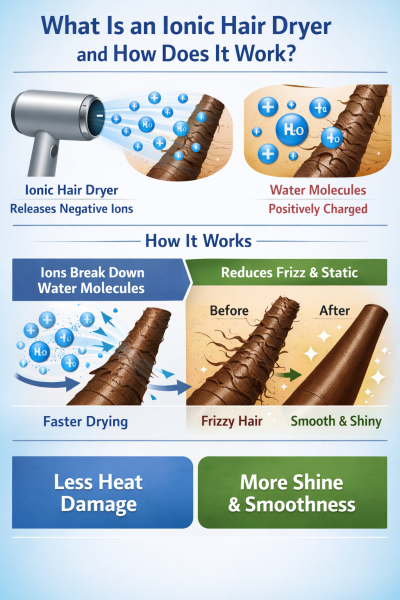
At its core, an ionic hair dryer emits negatively charged ions during the drying process. These ions interact with positively charged water molecules trapped in your hair, effectively breaking them into smaller droplets. The result? Water evaporates from your strands significantly faster, meaning less prolonged heat exposure and dramatically reduced drying time.
But the benefits don’t stop at speed. Those same negative ions also neutralize the static charge on your hair — the main culprit behind frizz and flyaways. When your hair carries an even charge distribution, the cuticle (the outermost layer of each strand) lies flat instead of standing on end. Flat cuticles mean smoother surfaces, which means more light reflection, which translates directly into visible shine.
Traditional dryers work by blasting hot, dry air at your hair — essentially cooking the moisture out. Ionic dryers work smarter, not harder, by attacking water molecules at the molecular level while the cuticle remains sealed. This fundamental difference is what separates a good hair day from a great one.
Who Benefits Most from Ionic Technology?
While virtually everyone can benefit from ionic technology, certain hair types see the most dramatic improvements:
• Thick or coarse hair: High-density hair takes longer to dry and is more prone to frizz. Ionic technology slashes drying time and keeps texture smooth.
• Curly and wavy hair: Curls are naturally more porous and prone to humidity-induced frizz. Negative ions seal the cuticle to preserve definition and eliminate puffiness.
• Color-treated or chemically processed hair: Processed hair is more fragile and vulnerable to heat damage. Ionic drying reduces the time heat is in contact with your strands, protecting color vibrancy and structural integrity.
• Fine or delicate hair: Fine strands are easily overwhelmed by conventional heat. Ionic dryers let you use lower heat settings while still achieving efficient drying.
• Anyone in a hurry: Even if your hair is low-maintenance, the speed alone makes ionic technology a worthwhile upgrade to your morning routine.
Key Features to Look for in a Quality Ionic Hair Dryer
Not all ionic dryers are created equal. Here’s what separates a truly exceptional tool from a mediocre one:
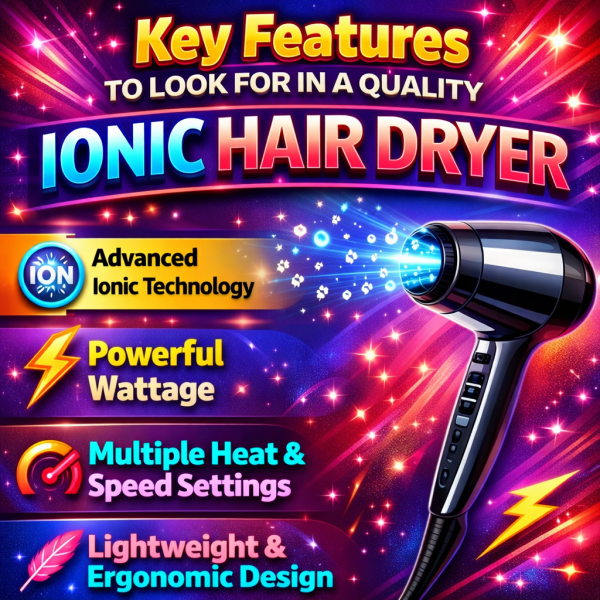
Motor Speed and Power
The motor is the heart of any hair dryer. High-speed motors — think 100,000 RPM and above — generate powerful airflow that moves water out of your hair rapidly. Many premium models now feature brushless DC motors, which are more efficient, quieter, and longer-lasting than traditional AC motors. Higher RPM doesn’t just mean faster drying; it also means more consistent airflow that distributes heat evenly, reducing hot spots that can cause damage.
Intelligent Temperature Control
Temperature consistency is one of the most underappreciated features in a hair dryer. The best models monitor outlet temperature dozens — sometimes hundreds — of times per second, automatically adjusting to prevent heat spikes. This real-time regulation protects your hair from accidental heat damage far more effectively than simply choosing a lower heat setting and hoping for the best.
Noise Level
Traditional hair dryers can reach noise levels comparable to a lawn mower — not exactly pleasant at 6 AM. Modern ionic dryers, particularly those with high-speed brushless motors, operate at significantly reduced decibel levels. If you live with others, dry your hair early in the morning, or simply value a more peaceful styling experience, noise level is worth factoring into your decision.
Attachments and Accessories
The right attachment can make a profound difference in your results. Concentrator nozzles direct airflow precisely, ideal for achieving a sleek, smooth blowout. Diffuser attachments distribute air broadly and gently — essential for curly and wavy hair types who want to enhance their natural texture without disturbing curl pattern. Premium ionic dryers often include multiple attachment options to accommodate different styling needs.
Weight and Ergonomics
If you have long or thick hair, drying time can stretch to ten minutes or more. A heavy dryer becomes genuinely uncomfortable over that duration. Look for lightweight designs that don’t sacrifice power for portability. Balance matters too — a well-distributed dryer reduces fatigue in your wrist and shoulder, making the entire styling process more comfortable.
Ionic vs. Ceramic vs. Tourmaline: Understanding the Differences
You’ll often see these terms used interchangeably or in combination, so it’s worth clarifying what each one actually means:
Ionic refers specifically to the emission of negative ions, which break down water molecules and reduce frizz as described above.
Ceramic describes the heating element material. Ceramic heats evenly and emits far-infrared heat, which penetrates the hair shaft gently from the inside out rather than blasting external heat. This reduces surface damage significantly.
Tourmaline is a semi-precious mineral that, when ground and embedded in heating elements, releases an especially high concentration of negative ions — up to six times more than standard ionic technology. It also emits far-infrared heat. Tourmaline-coated components are found in many premium dryers.
The best dryers typically combine all three technologies. The combination of ionic ion emission, ceramic heat distribution, and tourmaline amplification creates a synergistic effect that delivers superior results compared to any single technology alone.
Tips for Getting the Most Out of Your Ionic Hair Dryer
Owning a great ionic dryer is only half the equation. How you use it determines your results:
• Start with a microfiber towel: Regular towels cause friction and rough up the cuticle before you even turn on the dryer. Microfiber towels absorb water gently without causing mechanical damage or frizz.
• Apply a heat protectant: Even with ionic technology reducing heat exposure, a quality heat protectant adds an extra layer of defense. Look for products with ingredients like dimethicone or cyclomethicone that form a protective barrier around each strand.
• Keep the dryer moving: Hovering in one spot concentrates heat and increases damage risk. Keep the dryer moving continuously through sections of hair.
• Dry in sections: Clip hair into sections and work through one at a time. This ensures every strand gets dried properly without over-drying some areas while others stay wet.
• Finish with a cool shot: The cool shot button is not just a gimmick. Finishing each section with a burst of cool air sets the cuticle in a closed, smooth position, locking in your style and adding an extra dimension of shine.
• Point downward: Always direct airflow down the hair shaft — from root to tip — rather than against it. This encourages the cuticle to lie flat rather than roughing it up.
The Rise of High-Speed Ionic Dryers: A New Standard
In recent years, a new category of ionic dryers has emerged: the high-speed hair dryer. These next-generation tools combine ultra-powerful brushless motors (often running at 100,000 RPM or more) with advanced ionic technology and intelligent heat management systems. The result is a dryer that can handle even the thickest hair in a fraction of the time of traditional models — without compromising on health or finish quality.
High-speed ionic dryers have gained a devoted following among both professional stylists and discerning home users. The combination of speed, precision heat control, reduced noise, and superior ionic output creates an experience that’s genuinely difficult to go back from once you’ve tried it.
If you’re ready to experience this level of performance for yourself, exploring a dedicated collection of advanced ionic hair dryer models is a natural starting point. Laifen’s lineup, for example, showcases exactly how far the technology has come, with models designed for everything from everyday use to salon-level results.
Common Myths About Ionic Hair Dryers — DebunkedMyth 1: Ionic dryers are only for frizzy hair
While frizz reduction is one of the most celebrated benefits, the speed advantage, reduced heat damage, and enhanced shine are valuable for all hair types — including straight, low-porosity hair that may not struggle with frizz at all.
Myth 2: More ions always means better results
While ion output matters, it’s only one piece of the puzzle. Motor quality, heat distribution, airflow design, and temperature control all play equally important roles. A dryer with high ion output but poor heat management can still damage hair.
Myth 3: Ionic dryers make fine hair limp
This concern is occasionally raised, and while it’s true that smoothing the cuticle can reduce some surface texture, modern ionic dryers with adjustable settings allow fine-haired users to control the degree of smoothing. Many fine-hair users actually find ionic technology beneficial for reducing the static that makes their hair unmanageable.
Making Your Decision: What Really Matters
When the time comes to choose your ionic hair dryer, resist the temptation to focus exclusively on wattage. Wattage tells you about raw power, but it doesn’t tell you about motor efficiency, heat precision, ion output, or build quality — all of which matter more for long-term results and hair health.
Think about your specific hair type and styling goals first. Long, thick hair benefits from maximum airflow and power. Fine or color-treated hair needs precision temperature control. Curly hair demands a good diffuser attachment. Frequent travelers need a compact, dual-voltage design. Matching the dryer’s strengths to your actual needs will serve you far better than chasing the highest spec on paper.
Also consider the long-term value proposition. A quality ionic dryer represents an investment, but one that pays dividends every single morning. When you factor in the reduced need for heat damage repair treatments, the time saved in your daily routine, and the confidence that comes with consistently great hair, the math makes a compelling case for choosing quality over budget.
Final Thoughts
The ionic hair dryer isn’t just a minor upgrade — it represents a fundamentally different approach to drying and styling hair. By working at the molecular level to break down water and neutralize static charge, ionic technology delivers results that conventional dryers simply cannot match: faster drying, smoother finish, deeper shine, and significantly less damage over time.
Whether you’re a longtime beauty enthusiast who already knows the benefits or someone just beginning to explore their options, upgrading to a quality ionic dryer is one of the most impactful changes you can make to your hair care routine. The difference shows up every single day — in the mirror, in how your hair feels, and in how long your color and condition hold up over time.
Your hair deserves tools that work as hard as you do. An ionic hair dryer, chosen thoughtfully and used correctly, is one of the most reliable ways to ensure it always looks its absolute best.
Media Contact
Company Name: Laifen Inc.
Email: Send Email
Country: United States
Website: https://www.laifentech.com/collections/hair-dryers