
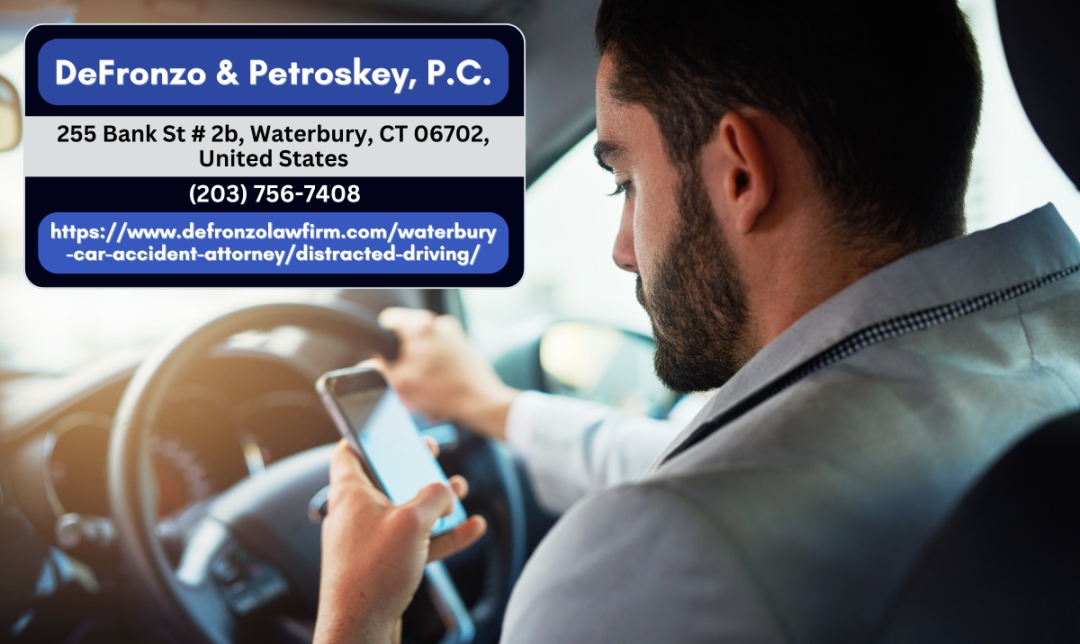
WATERBURY, CT – Distracted driving contributes to thousands of motor vehicle collisions annually in Connecticut, with the Connecticut Crash Data Repository reporting over 5,000 distracted driving crashes statewide in 2022 that resulted in eight fatalities and nearly 800 injuries. Waterbury distracted driving attorney Dan Petroskey of DeFronzo & Petroskey, P.C. (https://www.defronzolawfirm.com/waterbury-car-accident-attorney/distracted-driving/) is providing guidance on how injury victims can hold negligent drivers accountable and pursue compensation for medical expenses, lost income, and ongoing care needs.
According to Waterbury distracted driving attorney Dan Petroskey, these crashes often cause severe injuries because distracted drivers have no time to brake or avoid impact. The National Highway Traffic Safety Administration classifies distractions as visual (eyes off the road), manual (hands off the wheel), and cognitive (mind off driving). Texting while driving is particularly dangerous because it combines all three types simultaneously.
Waterbury distracted driving attorney Dan Petroskey emphasizes that Connecticut law prohibits handheld phone use and texting while driving under Connecticut General Statutes Section 14-296aa. Drivers may not hold a phone, send or read text messages, or access email while their vehicle is in motion. Violations carry escalating penalties, with a first offense resulting in a $200 fine, a second offense within two years bringing a $375 fine, and a third or subsequent offense costing $625. These fines are doubled if the violation occurs in a work zone.
“Beyond criminal penalties, violating this law creates strong evidence of negligence in a civil claim,” explains Petroskey. “When a driver violates Section 14-296aa and causes a crash, that violation helps establish liability under Connecticut’s comparative negligence rule.”
Attorney Petroskey notes that common distractions include reading text messages, checking GPS navigation, eating food, drinking coffee, adjusting the radio, talking on the phone, and having intense conversations with passengers. Waterbury sees frequent distracted driving crashes on Interstate 84 through downtown, Route 8 near Waterbury Hospital, and busy intersections like East Main Street and Meadow Street.
Proving distraction requires gathering multiple types of evidence before it disappears. Petroskey can obtain cell phone records showing the time and duration of calls, texts, and data usage at the moment of impact. Police reports from Connecticut State Police and Waterbury Police Department provide documentation of officer observations, driver admissions of phone use, and citations issued under the distracted driving statute. Witness testimony from other drivers, passengers, or pedestrians can establish that the at-fault driver was looking at their phone or engaging in other distracting behavior before the crash.
“Phone records must be preserved quickly before they’re lost or destroyed,” advises Petroskey. “Carriers typically retain detailed records for limited periods, sometimes as short as one to two years.”
Distracted driving crashes often result in serious injuries including whiplash and soft tissue damage, broken bones and fractures, traumatic brain injuries, spinal cord injuries, and internal bleeding or organ damage. According to the Connecticut Department of Public Health, motor vehicle crashes are the leading cause of traumatic brain injury-related emergency department visits for adults aged 15-44 in the state.
Connecticut law allows injury victims to recover compensation for both economic and non-economic damages. Economic damages include emergency room treatment, ambulance transport, hospital admission costs, surgery expenses, prescription medications, physical therapy, rehabilitation, lost wages from missing work during recovery, and property damage to repair or replace the vehicle. Non-economic damages compensate for physical pain and suffering, mental anguish, anxiety or depression following the crash, loss of enjoyment of life, and scarring or disfigurement from visible injuries.
Connecticut’s statute of limitations gives injury victims two years from the date of the accident to file a personal injury lawsuit. According to Connecticut General Statutes Section 52-584, missing this deadline typically means losing the right to pursue compensation through the courts.
For those injured in distracted driving crashes in Waterbury or throughout New Haven County, contacting an experienced personal injury attorney may help protect legal rights and establish the full value of damages. DeFronzo & Petroskey, P.C. handles cases on a contingency fee basis, meaning clients pay no legal fees unless compensation is recovered on their behalf.
About DeFronzo & Petroskey, P.C.:
DeFronzo & Petroskey, P.C. is a Waterbury-based law firm dedicated to personal injury representation. Led by attorney Dan Petroskey, who has represented Connecticut injury victims since 2004, the firm serves clients throughout New Haven County. The firm has served Waterbury families since 1961 and provides bilingual services in English and Spanish. For consultations, call (203) 756-7408.
Embeds:
Youtube Video: https://www.youtube.com/watch?v=I6ubiuOvtJ8
GMB: https://www.google.com/maps?cid=2074756120617399372
Email and website
Email: iacruz@defronzolaw.com
Website: https://www.defronzolawfirm.com/
Media Contact
Company Name: DeFronzo & Petroskey, P.C.
Contact Person: Dan Petroskey
Email: Send Email
Phone: (203) 756-7408
Address:255 Bank St # 2b
City: Waterbury
State: Connecticut 06702
Country: United States
Website: https://www.defronzolawfirm.com/