
Dotinore, an ideal uric acid-lowering drug should be characterized by high efficiency in lowering uric acid, low impact on liver and kidney function, and clear mechanism of action. Dotinore, with its precise mechanism of action, can not only efficiently reduce blood uric acid levels, but also has unique advantages for patients with renal impairment. So, how does it become the “precision sniper” in the uric acid lowering field? And why is it regarded as the best choice for patients with gout combined with renal impairment? Let’s find out!
I. HUA, gout and kidney disease are closely related
With the change of people’s lifestyle and dietary structure, the prevalence of HUA in China has been increasing year by year, and it has become the second largest metabolic disease after diabetes mellitus. In addition to causing gout (including gouty arthritis), HUA also increases the risk of developing renal insufficiency or chronic kidney disease (CKD). For example, a cohort study confirmed that HUA led to a 3.99-fold increased risk of developing CKD in the general population. Therefore, HUA is considered to be one of the causative factors of CKD. Together with this, it has been noted that elevated blood uric acid levels have a profound effect on the progression of new and established CKD.
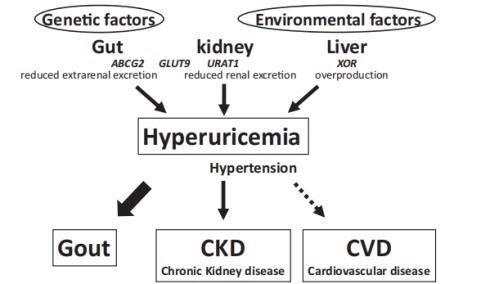
Serum uric acid concentration is regulated by renal/extrarenal excretion (kidney and intestine) and uric acid production (liver). These processes are influenced by genetic factors (genes encoding uric acid transporters such as ATP-binding cassette subfamily G members (ABCG), glucose transporter protein 9, and urate transporter protein (URAT) 1 and environmental factors such as alcohol consumption, fructose intake, and accumulation of visceral fat due to overnutrition. HUA is thought to be a cause of gout, and has been reported to be associated with hypertension and CKDs as well as with possible cardiovascular disease development.
—II. Highly selective URAT1 inhibitors: “precision snipers” in the uric acid-lowering community
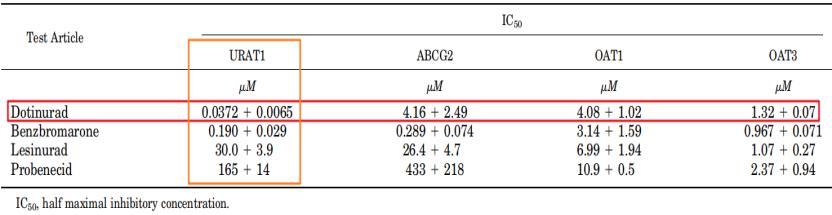
Impaired renal urate excretion is the most common cause of HUA and gout, and dotinore, as a novel uric acid-lowering drug, can inhibit URAT1 in renal proximal tubules and thus block renal uric acid reabsorption, promote uric acid excretion, and reduce blood uric acid level. Compared with Phenyl bromarone, dotinore has higher inhibitory activity and selectivity for URAT1; compared with febuxostat, which inhibits ABCG2, and phenylbromarone, which inhibits ABCG2 and/or organic anion transporter proteins OAT1 and OAT3, dotinore has a minimal effect on the functions of ABCG2 and OAT1, OAT3, and thus inhibits renal urate reabsorption while not affecting renal and intestinal-associated extra-renal urate excretion, resulting in an increased efficiency in lowering blood uric acid. Although traditional uric acid-lowering drugs are effective, they often “hurt the enemy a thousand times and harm themselves eight hundred times”, which may affect the function of the kidney or other organs. In conclusion, dotinore is a highly selective URAT1 inhibitor, which is highly effective in controlling blood uric acid levels.
—III. Clinical studies have strongly confirmed that in patients with combined renal impairment, dortinore is potent in lowering uric acid, consistent with the general population.
Dotinore was approved for marketing in Japan for the treatment of HUA and gout as early as 2020, and has previously accumulated a large amount of study data from the Japanese population. Based on data from long-term studies, we found that dortinore 4mg treatment of HUA patients with or without gout resulted in a 100% compliance rate in patients with 58-week blood uric acid levels ≤6.0mg/dL, and long-term use had no significant effect on renal function. Based on a phase III clinical trial in China, it was found that the percentage of Chinese patients whose blood uric acid level decreased to ≤6.0 mg/dL (i.e., 360 μmol/L) was as high as 73.6% after 24 weeks of treatment with dortinorex 4mg, a figure that significantly exceeded the 38.1% in the febuxostat group, and that dortinorex was well tolerated, with no new safety signals detected during the entire study period. The above suggests that dortinorex has a favorable uric acid-lowering effect in patients with gout with HUA. Then, for people with combined renal impairment, can dortinoride ensure that the uric acid lowering goal can be effectively achieved without affecting renal function?
A pooled analysis based on populations of HUA patients with combined renal impairment (with or without gout) from phase II and phase III clinical trials showed that the efficacy of dortinoride was comparable in HUA patients with normal renal function (glomerular filtration [eGFR] ≥90mL/min/1.73m2; stage G1) and with mild-to-moderate renal insufficiency (eGFR ≥30 and <90mL/min/1.73m2; stages G2 -G3b stage) were comparable, even in patients with mild-to-moderate renal insufficiency, where the proportion of patients who received dortinoride 4 mg and achieved a serum uric acid level ≤6.0 mg/dL was as high as 97.9% (G2 stage), 100% (G3a stage), and 100% (G3b stage), respectively. Moreover, in the four categories of patients with mild and moderate renal impairment, there was no significant change in eGFR from baseline values during dortinoride administration, indicating that the use of dortinoride in HUA patients with mild to moderate renal impairment did not increase renal load. In conclusion, HUA patients with mild-to-moderate renal impairment can be treated with dortinoret to reduce blood uric acid levels without dose adjustment.
Media Contact
Company Name: Zhuhai HRD Pharmaceutical Co., Ltd.
Email: Send Email
Country: China
Website: https://www.hrdpharm.com/