
Introduction | Cotton Market Outlook 2025–2030
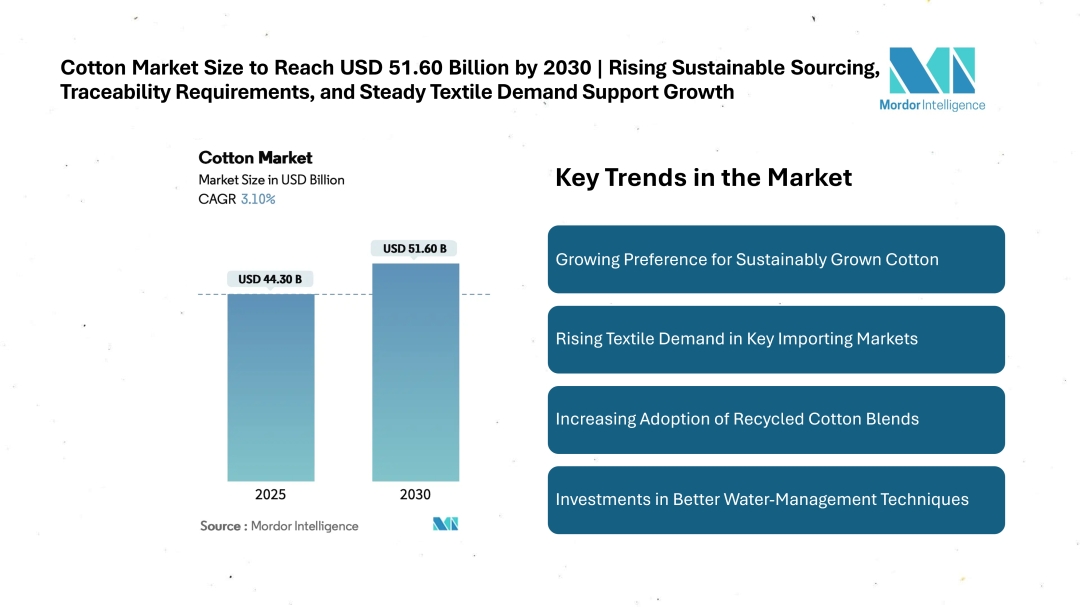
The cotton market continues to play a central role in the textile and apparel supply chain, supported by stable demand from major manufacturing hubs and ongoing sustainability requirements set by international brands. According to Mordor Intelligence research, the cotton market sizeis expected to reach USD 44.30 billion in 2025 and grow to USD 51.60 billion by 2030, reflecting a 3.1% CAGR during the forecast period.
While the industry faces consistent challenges such as climatic variability, pest resistance, and trade policy shifts, it also benefits from expanding certified-sustainable production systems, increasing adoption of recycled fiber blends, and stricter traceability frameworks that favor transparent supply chains.
As apparel companies adjust their sourcing models to meet regulatory and consumer expectations, cotton remains a critical raw material with strong long-term relevance in manufacturing, especially across Asia-Pacific textile clusters.
Key Trends | Major Developments Driving the Cotton Market
Growing Preference for Sustainably Grown Cotton
Retailers are increasingly prioritizing verified sustainable cotton sources as part of broader environmental commitments. The rise of programs such as the Better Cotton Initiative (BCI) has encouraged growers across multiple regions to adopt responsible farming practices focused on water-use efficiency, soil management, and reduced chemical inputs.
With more apparel chains integrating sustainable fiber targets into procurement contracts, certified lint continues to move from an optional category to a routine sourcing requirement. This shift is helping farmers gain better access to international markets and maintain pricing stability.
Rising Textile Demand in Key Importing Markets
Countries such as Bangladesh, Vietnam, Indonesia, and China remain major cotton-importing hotspots due to their large spinning and garment manufacturing bases. Mills in these regions require consistent, high-quality fiber to support yarn production for export-led apparel industries.
As capacity expansions continue in South and Southeast Asia, these countries are expected to maintain a strong import footprint, thereby supporting cotton trade volumes. The need for uniform fiber characteristics and reliable delivery timelines further strengthens the role of organized cotton suppliers, exporters, and ginning operations.
Increasing Adoption of Recycled Cotton Blends
The focus on circularity and waste reduction has encouraged apparel manufacturers to incorporate more recycled cotton into their product lines. Although recycled fiber currently represents a small fraction of supply, its adoption is growing rapidly due to brand commitments linked to environmental impact reduction.
Mechanical recycling dominates the market, but innovations in chemical recycling are improving fiber recovery rates and expanding the potential for high-quality recycled cotton blends. Despite this growth, cotton remains essential since recycled fibers require virgin cotton to maintain yarn strength and quality.
Investments in Better Water-Management Techniques
Water availability challenges continue to push farmers toward efficient irrigation practices. Modern tools such as soil-moisture sensors, controlled-drip systems, and automated irrigation scheduling help growers optimize water use while maintaining yield quality.
Countries such as the United States, Australia, and parts of Asia are increasingly adopting these methods to counter water stress, protect soil health, and secure long-term productivity. Improved irrigation efficiency is also becoming a key resilience factor in regions facing unpredictable weather conditions.
Dive deeper into regional dynamics and download the Japanese version for locally relevant analysis – https://www.mordorintelligence.com/ja/industry-reports/cotton-market?utm_source=abnewswire
Cotton Market Segmentation Breakdown
By Geography
The cotton market is segmented into several major regions, each contributing unique production, export, or consumption characteristics:
North America
- High adoption of precision agriculture
- Consistent fiber quality and structured classing systems
Asia-Pacific
- Largest consumption base driven by the textile and spinning industries
- Strong import dependence in countries like Bangladesh and Vietnam
Europe
- Limited production but steady demand for premium-quality fibers
South America
- Growing export hubs, especially Brazil
Middle East & Africa
- Rising ginning capacity and improving agricultural input access
Key Players | Competitive Landscape in the Cotton Market
The cotton market is moderately consolidated, with a mix of producer cooperatives, government agencies, ginners, exporters, and multinational merchants contributing to supply and trade flows. Key companies are actively focusing on traceability, sustainable sourcing agreements, logistics efficiency, and expanding their presence in high-demand textile hubs.
Major players typically engage in forward contracts, quality certification processes, and region-specific procurement strategies to maintain reliable relationships with spinning mills and apparel manufacturers. In addition, several government-backed organizations in large producing countries manage procurement, price support, and buffer stocks to stabilize the domestic cotton sector.
Conclusion | Outlook for the Cotton Market
The cotton market is set to maintain steady growth through 2030, supported by rising textile production, enhanced sustainability requirements, and structural shifts toward transparent sourcing. While the industry must continue navigating water constraints, pest management challenges, and evolving regulatory expectations, cotton remains central to apparel and home-textile value chains.
With key importing nations expanding manufacturing capabilities and retailers reinforcing their sustainable fiber goals, the next five years offer opportunities for growers, exporters, and certified producers to strengthen their position in the cotton market. Improved farming practices, efficient irrigation systems, and robust traceability solutions will shape the market’s long-term competitiveness and growth outlook.
Our Trending Reports
Maize Market – The Maize Market Report is Segmented by Geography (North America, South America, Europe, Asia-Pacific, the Middle East, and Africa). The Report Includes Production Analysis (Volume), Consumption Analysis (Value and Volume), Export Analysis (Value and Volume), Import Analysis (Value and Volume), and Price Trend Analysis. The Market Forecasts are Provided in Terms of Value (USD) and Volume (Metric Tons).
Get More Insights: https://www.mordorintelligence.com/industry-reports/maize-market?utm_source_abnewswire
Plums and Sloes Market – The Plums and Sloes Market Report is Segmented Based On Geography Into North America, Europe, Asia Pacific, South America and Africa, and the Middle East, Covering all the Major Countries. The Report Provides An Analysis of the Production, Consumption, Export, Import, and Price Trends of the Commodity Globally. The Report Offers Market Size and Forecasts in Value (USD) and Volume (Metric Tons) for all the Above Segments.
Get More Insights: https://www.mordorintelligence.com/industry-reports/plums-and-sloes-market?utm_source=abnewswire
Rice Market – The Rice Market Report is Segmented by Geography (North America, Europe, Asia-Pacific, South America, Middle East, and Africa). The Report Includes Production Analysis (Volume), Consumption Analysis (Value and Volume), Export Analysis (Value and Volume), Import Analysis (Value and Volume), and Price Trend Analysis. The Market Forecasts are Provided in Terms of Value (USD) and Volume (Metric Tons).
Get More Insights: https://www.mordorintelligence.com/industry-reports/rice-market?utm_source=abnewswire
About Mordor Intelligence:
Mordor Intelligence is a trusted partner for businesses seeking comprehensive and actionable market intelligence. Our reach, expert team, and tailored solutions empower organizations and individuals to make informed decisions, navigate complex markets, and achieve their strategic goals.
With a team of over 550 domain experts and on-ground specialists spanning 150+ countries, Mordor Intelligence possesses a unique understanding of the business landscape. This expertise translates into comprehensive syndicated and custom research reports covering a wide spectrum of industries, including aerospace & defense, agriculture, animal nutrition and wellness, automation, automotive, chemicals & materials, consumer goods & services, electronics, energy & power, financial services, food & beverages, healthcare, hospitality & tourism, information & communications technology, investment opportunities, and logistics.
Media Contact
Company Name: Mordor Intelligence Private Limited
Contact Person: Jignesh Thakkar
Email: Send Email
Phone: +1 617-765-2493
Address:11th Floor, Rajapushpa Summit, Nanakramguda Rd, Financial District, Gachibowli
City: Hyderabad
State: Telangana 500008
Country: India
Website: https://www.mordorintelligence.com/industry-reports/cotton-market?utm_source=abnewswire